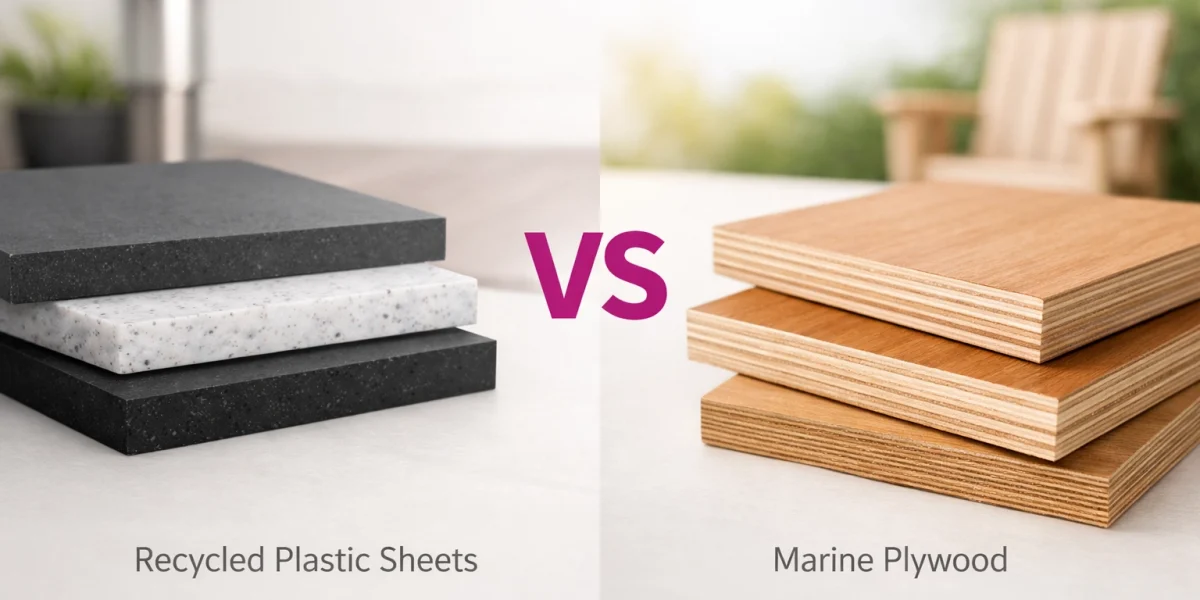
If you’ve ever built a deck, a boat trailer, or a garden bed in Australia, you know the drill. You head to the hardware store, look at the timber section, and inevitably end up staring at the marine plywood. It’s been the "gold standard" for wet-area construction for decades. But as we move into 2026, the conversation is shifting toward sustainable construction materials in Australia, and one contender is consistently outperforming the old guard: recycled plastic sheets.
At Resourceful Living, we talk to builders, DIYers, and industrial project managers every day who are tired of the "replace and repeat" cycle of timber. They want something that survives the Australian sun and the coastal salt without needing a weekend of sanding and staining every year.
So, if you’re weighing up whether to stick with marine ply or make the jump to recycled plastic panels, let’s look at the hard data, the maintenance requirements, and the true cost of ownership.
What Exactly is Marine Plywood? (And What It Isn't)
Before we compare the two, we need to clear up a common myth. Marine plywood is not waterproof.
It is manufactured using high-quality face and core veneers with minimal gaps (voids) to prevent water from getting trapped inside. It uses A-bond permanent glue (Phenol Formaldehyde), which is designed to withstand boiling water and high humidity. However, the wood itself is still organic. If the edges aren't sealed perfectly, or if the surface coating is scratched, moisture will get in.
The Downside of Marine Plywood in 2026:
- High Maintenance: Requires constant sealing, painting, or varnishing.
- Delamination Risk: Over time, the layers can separate when exposed to extreme moisture cycles.
- Environmental Cost: While wood is renewable, high-grade marine ply often relies on old-growth timber or specific tropical hardwoods.
- Susceptibility: It is still vulnerable to termites, fungal rot, and marine borers.
The New Standard: Recycled Plastic Sheets
On the other side of the ring, we have recycled plastic sheets. These aren't just "plastic boards." They are high-density panels manufactured by diverting post-consumer and industrial waste from landfills.
Because they are made from materials like HDPE (High-Density Polyethylene) and LDPE, they are inherently waterproof. Not "water-resistant": waterproof.
"For every 72 sheets of ½-inch recycled plastic used instead of plywood, one tree is saved."
This isn't just a win for the planet; it’s a win for the longevity of your build. You can learn more about how this fits into the recycled plastic circular economy and why it’s becoming the go-to for future sustainable building.

Head-to-Head Comparison: The Metrics That Matter
1. Water and Weather Resistance
This is the single biggest differentiator. In the Australian climate, we deal with intense UV followed by torrential rain.
- Marine Plywood: It can handle the wet, but only if the "envelope" of the wood is maintained. Once moisture finds its way into a screw hole or a cut edge, the timber swells, and the rot begins.
- Recycled Plastic Sheets: These panels are impermeable. You could submerge a Resourceful Living panel for 20 years, and it wouldn't absorb a single drop of water. They will not rot, split, crack, or delaminate. In marine environments where saltwater is a factor, plastic is the undisputed king because it is chemically inert.
2. Durability and Structural Integrity
When we look at sustainable construction materials in Australia, we have to talk about tensile strength.
- Marine Plywood: Offers excellent weight-to-strength ratios initially. However, its structural integrity degrades as the wood fibres break down over time due to weather exposure.
- Recycled Plastic Sheets: These sheets exhibit high tensile strength (typically 3,500–5,000 psi). They are also impact-resistant. If you drop a heavy tool on a plastic panel, it bounces. If you drop it on plywood, you might crack a veneer, creating a gateway for moisture.
3. Maintenance: The "Silent" Cost
How much is your time worth?
- Marine Plywood: Expect to sand, re-seal, or paint your plywood every 12 to 24 months if it’s outdoors. If you miss a cycle, the lifespan of the material drops drastically.
- Recycled Plastic Sheets: They are maintenance-free. They don't need painting, oiling, or staining. If they get dirty, you hit them with a pressure washer or a bucket of soapy water. That’s it.
For commercial applications, this reduction in labor is a massive financial incentive. You can see a detailed breakdown of these long-term savings in our guide on recycled plastic vs timber vs steel cost and lifespan.
The Financial Reality: Initial vs. Lifecycle Cost
Let’s be honest: recycled plastic sheets usually have a higher upfront purchase price than marine plywood. If you are only looking at your bank balance on the day of purchase, plywood looks like the winner.
However, smart builders look at the Total Cost of Ownership (TCO).
| Feature | Marine Plywood | Recycled Plastic Sheets |
|---|---|---|
| Initial Cost | Moderate | Higher |
| Sealing/Painting Cost | Ongoing ($$$) | Zero |
| Lifespan | 5–10 years (with care) | 20+ years |
| Replacement Frequency | High | Low |
| Resale/Recycle Value | Low (Landfill) | High (Fully Recyclable) |
By year five, the cost of the plywood (plus the sealants and the labor to apply them) usually overtakes the cost of the plastic panels. By year ten, the plywood is likely being replaced, while the plastic panel is still performing like day one.

Sustainability: Beyond the Buzzwords
As an Australian manufacturer, we are seeing a massive push toward eco-friendly building products.
Marine plywood, while being a "natural" product, often uses resins containing Formaldehyde (VOCs). When you cut it, you're releasing those chemicals.
Recycled plastic panels from Resourceful Living take waste that was destined for an Australian landfill: milk bottles, soft plastics, and industrial scraps: and turn it into a high-value asset. We’ve even mapped out the life cycle environmental impact of recycled plastic panels to show exactly how much carbon and waste is diverted through this process.
Workability: Is it Hard to Use?
A common concern is that plastic is "harder" to work with than wood. This is a misconception.
Recycled plastic sheets can be worked with standard woodworking tools.
- Sawing: Use a standard circular saw or table saw (a fine-tooth blade works best).
- Drilling: Standard high-speed steel bits work perfectly.
- Fastening: You can use screws just like you would with timber. However, because plastic expands and contracts slightly more than wood with temperature changes, we recommend pre-drilling slightly larger pilot holes.
- No Splinters: Unlike marine ply, these sheets don’t splinter, making them much safer for high-traffic areas like playgrounds or animal enclosures.
Best Use Cases for Recycled Plastic Sheets
While marine plywood still has its place in internal structural flooring for boats (where weight is the absolute primary concern), recycled plastic is the superior choice for:
- Animal Husbandry: Washable, hygienic, and chew-proof. (Check out our mining rehabilitation products for similar rugged applications).
- Outdoor Kitchen Cabinetry: Completely waterproof and won't warp near the BBQ.
- Garden Beds and Retaining Walls: No chemicals leaching into your soil, unlike treated timber.
- Marine Docks and Jetties: Stands up to salt spray and constant submersion.
- Industrial Flooring: Excellent for areas that require frequent wash-downs.
The Verdict
If your project is indoors and stays dry, marine plywood is a fine, cost-effective choice.
But if your project is going to live outside, deal with the Australian rain, or sit in a high-moisture environment, recycled plastic sheets are the better investment. You aren't just buying a panel; you're buying back your future weekends and ensuring your build doesn't end up in a skip bin in five years.
Ready to make the switch?
If you're looking to source high-quality, Australian-made sustainable construction materials, we can help.
- Explore our range: Resourceful Living Products
- Learn how to audit your own waste: Waste Audit Template
- Understand the ROI: Reduce Landfill Costs with Circular Procurement
The future of Australian building isn't just about what looks good today: it's about what lasts until tomorrow. Don't settle for materials that rot. Choose the resourceful way.