If you’ve been in a site shed or a procurement meeting lately, you’ve probably heard the term EPD being thrown around more than ever. It’s no longer just a "nice-to-have" document tucked away in a sustainability folder; in 2026, it has become the entry ticket for any serious infrastructure or commercial project in Australia.
The days of simply saying a product is "eco-friendly" or "made from recycled milk bottles" are over. Project managers, architects, and government departments now demand hard data to back up those claims. They need to know the exact carbon cost of every material arriving on-site to satisfy increasingly strict embodied carbon reporting Australia requirements.
At Resourceful Living, we’re seeing a massive shift. General sustainability claims are being replaced by rigorous, third-party verified data. Here is why product-specific Environmental Product Declarations (EPDs) are the new gold standard for recycled plastic sheets Australia.
The Death of "Vague" Sustainability in 2026
In the past, "recycled" was enough of a buzzword to get you through a tender. But as we move further into 2026, the Australian building industry has matured. We are now operating under strict mandates where embodied carbon: the emissions associated with manufacturing, transporting, and installing building materials: is scrutinized just as heavily as operational energy.
If you can’t prove the carbon footprint of your materials, you’re essentially flying blind. This is where the EPD comes in. Think of it as a nutrition label for building materials. Just as you’d check a label for sugar or protein, an EPD tells you exactly what "ingredients" went into a product and what environmental "toll" it took to get it to your site.
What exactly is an EPD?
An Environmental Product Declaration (EPD) is a standardised document based on a Life Cycle Assessment (LCA). It quantifies the environmental impact of a product across its entire life. It isn't just a marketing brochure; it's a verified report that follows international standards like ISO 14025 and EN 15804.
Product-Specific vs. Generic EPDs: Why the Difference Matters
This is where many projects get tripped up. There are two types of EPDs, and using the wrong one can actually penalise your project’s sustainability rating.
- Generic/Industry-Average EPDs: These are based on the "average" data for a material (e.g., an "average plastic panel"). While better than nothing, they often use worst-case scenario data.
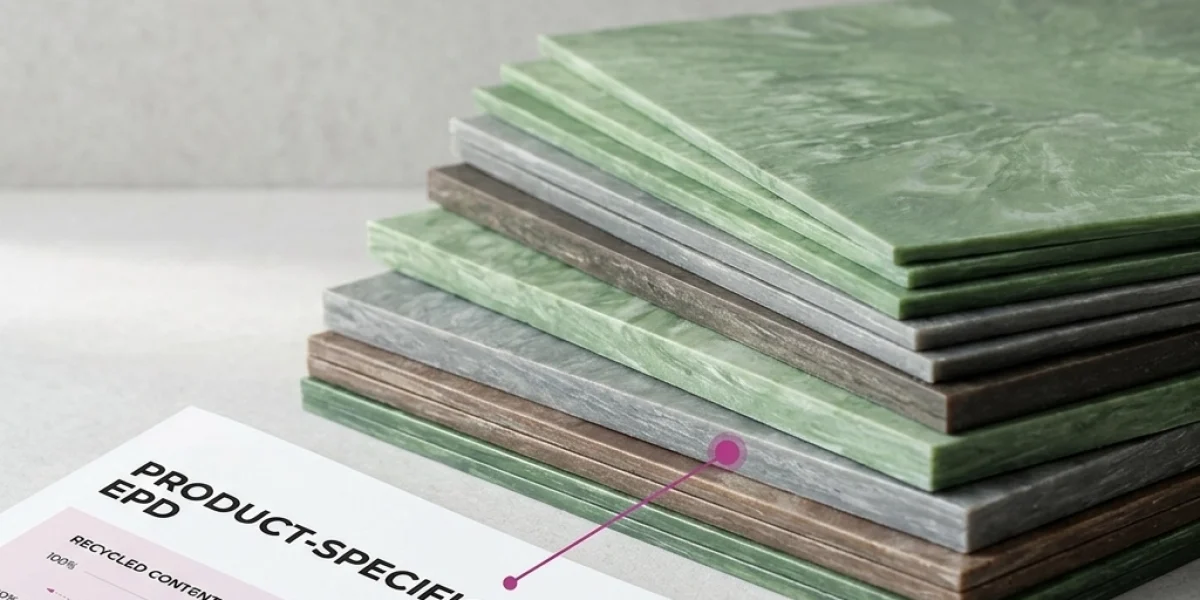
- Product-Specific EPDs: These are calculated for one specific product from a specific manufacturer: like our 100% recycled plastic sheets.
If you use a generic EPD for recycled plastic sheets Australia, you’re often being measured against a product that might contain virgin resins or be manufactured using high-emission energy grids. By using a product-specific EPD, you get the full credit for our low-carbon manufacturing process and 100% recycled feedstock.
Meeting NCC and NABERS Standards in 2026
The National Construction Code (NCC) and NABERS have raised the bar. To hit your targets, you need more than just a gut feeling that a material is "green."
- NABERS Embodied Carbon: This framework now requires accurate reporting on the "upfront" carbon of materials. Product-specific EPDs provide the primary data needed to ensure your building doesn't exceed its carbon budget.
- Green Star Ratings: The Green Building Council of Australia (GBCA) gives significantly more "points" to products that provide third-party verified, product-specific EPDs.
- Government Tenders: More state and federal contracts now include clauses that mandate EPDs for all major building elements.
Without this data, you might find yourself losing government tenders to competitors who have their documentation in order.
The "A4" Advantage: Why Australian Made Wins
When calculating embodied carbon reporting Australia, we look at different life cycle stages. Stage A4 is a big one: Transport to Site.
This is where imported "sustainable" materials often fail. You might find a recycled plastic sheet from Europe that looks great on paper, but by the time it has been shipped halfway across the world, its carbon footprint has exploded.
"A product is only as sustainable as the journey it took to get to you. If a 'green' material travels 15,000km to reach an Australian site, you’ve already lost the carbon battle before the first sheet is even installed."
By choosing Australian Made recycled plastic sheets, you are slashing the A4 transport emissions. Because our materials are sourced from Australian waste and manufactured locally, the carbon "toll" of logistics is a fraction of that of imported alternatives. This makes a massive difference when you are trying to beat global supply chain delays and keep your carbon reporting low.
Traceability: The Secret Ingredient of a Good EPD
An EPD is only as good as the data that feeds into it. This is why traceability is the buzzword of 2026. You need to know that the "recycled plastic" in your sheets didn't just appear out of nowhere.
At Resourceful Living, we focus heavily on local traceability. We can tell you which Australian waste streams your sheets came from: whether it's kerbside milk bottles or industrial offcuts. This transparency is what allows a product-specific EPD to be truly accurate and reliable for your embodied carbon reporting.

How to Integrate EPD Data into Your Project
If you’re a procurement manager or a site supervisor, here’s how to use EPDs to your advantage:
- Request EPDs Early: Don't wait until the audit stage. Ask for product-specific EPDs during the tendering process.
- Compare the "GWP": Look for the Global Warming Potential (GWP) metric in the EPD. This is the kgs of CO2-equivalent per square metre. It’s the most direct way to compare the carbon impact of recycled plastic vs timber or concrete.
- Check the Scope: Ensure the EPD covers "Cradle-to-Gate" (Stages A1–A3) at a minimum. Ideally, look for "Cradle-to-Grave" to understand the end-of-life recycling potential.
- Use it for Tenders: Attach our EPDs to your project submissions. It shows the client that you are proactive about circular construction in 2026 and that your carbon claims are verified.
Why "Wait and See" is a Dangerous Strategy
The Australian construction industry is moving fast. With the 2026 mandates now in full swing, the window for "guessing" your environmental impact has closed. If you aren't using materials with product-specific EPDs, you are exposing your project to:
- Compliance Risks: Failing to meet NCC or NABERS requirements.
- Financial Risks: Missing out on "Green Financing" or sustainable building incentives.
- Reputational Risks: Being called out for greenwashing because you lack verified data.

The Bottom Line
Product-specific EPDs for recycled plastic sheets Australia aren't just paperwork: they are competitive currency. They prove that your commitment to sustainability is real, quantified, and verified.
When you choose a locally manufactured, 100% recycled product from Resourceful Living, you aren't just getting a durable building material. You’re getting the peace of mind that comes with knowing exactly where your material came from and exactly what its impact is.
Ready to secure the data you need for your next project? We are a Pre-Qualified Local Buy Supplier, making it even easier for councils and government bodies to source our traceable, low-carbon materials.

Take Action Today:
- Download our guide on integrating carbon reporting.
- Compare the long-term cost of recycled plastic vs plywood.
- Contact us for our latest product-specific data for your next tender.