In 2026, the Australian construction landscape has shifted. If you’re a builder or procurement officer, you’ve likely noticed that the lowest price no longer guarantees a winning bid. Embodied carbon reporting in Australia has moved from a "nice-to-have" sustainability metric to a hard requirement for Tier 1 contractors and government projects.
Whether you're aiming for a high NABERS rating or meeting the latest Green Star benchmarks, you need to prove the "carbon debt" of every material arriving on your site. If your tender lacks clear, data-backed embodied carbon figures, you're essentially bidding with one hand tied behind your back.
This guide provides a step-by-step framework to calculate embodied carbon for your next tender, ensuring your project is compliant, competitive, and future-proof.
Why Embodied Carbon is the New Currency of Construction
For years, the industry focused almost exclusively on operational carbon: the energy used to light, heat, and cool a building. However, as our grid becomes greener, the focus has shifted to the emissions generated before the keys are even handed over.
Embodied carbon includes the emissions from raw material extraction, transport, and manufacturing. In a typical new commercial build, this upfront carbon can account for up to 50% of the total lifecycle emissions.
"We're seeing a massive shift in the Aussie market. It's no longer about how much a material costs today; it's about what that material costs the project in carbon credits and compliance over the next five years." : Jess Hodge, Sales at Resourceful Living
Step 1: Define Your Boundary (Cradle-to-Gate)
Before you start crunching numbers, you must define what stages of the material's life you are measuring. In most 2026 construction tenders, the primary focus is on the "Upfront Carbon" (Stages A1-A3).
- A1: Raw Material Supply (e.g., harvesting timber or collecting plastic waste)
- A2: Transport (Moving raw materials to the factory)
- A3: Manufacturing (The energy used to create the final product)
By choosing 100% Australian recycled plastic sheets, you are effectively slashing the A1 and A2 stages. Because we use locally sourced waste, the "carbon debt" of extraction is replaced by a "carbon credit" for waste diversion.
Step 2: Collect Your Data Source (The Power of EPDs)
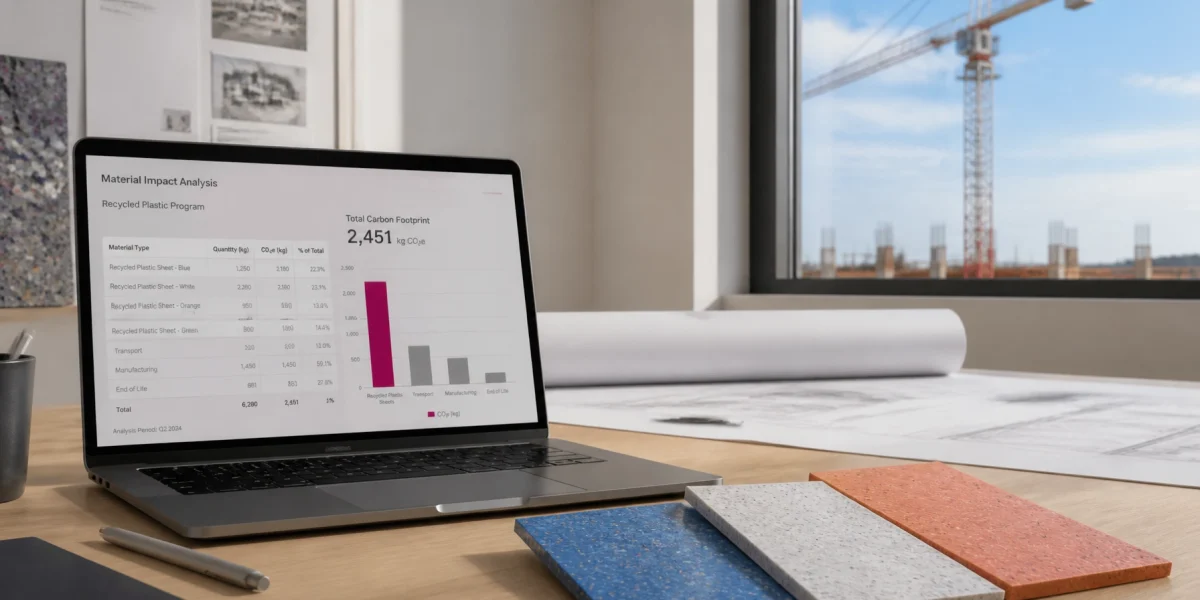
To calculate embodied carbon, you need an Environmental Product Declaration (EPD). Think of an EPD as a nutrition label for building materials. It provides a verified Global Warming Potential (GWP) value, usually expressed in kg CO2-e per unit (e.g., per square metre or per tonne).
⚠️ The Danger of "Industry Averages"
If your supplier cannot provide a product-specific EPD, your Life Cycle Assessment (LCA) consultant will be forced to use industry-average data.
- Industry averages are often padded by 20–40% to account for worst-case scenarios.
- Using generic data can make your project look "dirtier" on paper, potentially disqualifying you from high-value government tenders.
Pro Tip: Always prioritise suppliers like Resourceful Living who manage the end-to-end cycle. Our ability to trace plastic from local kerbside collection to final panel means your data is precise, not estimated.

Step 3: The Embodied Carbon Formula
While complex software like One Click LCA or eTool is often used for whole-building assessments, you can calculate the carbon for specific material swaps using this simple formula:
[Quantity of Material] × [Emission Factor (GWP)] = Total Embodied Carbon
Example: Replacing Plywood with Recycled Plastic
If you are specifying materials for a wet-area fit-out or outdoor infrastructure, comparing why plywood is costing builders more goes beyond the invoice price.
- Determine Quantity: Let's say you need 100 sheets of 2400mm x 1200mm panels.
- Find the GWP: Look at the EPD. A local, 100% recycled plastic panel will have a significantly lower GWP than treated timber or imported virgin plastics.
- Calculate: Multiply the total weight of those 100 sheets by the GWP per kg.
By performing this calculation early, you can demonstrate to the client exactly how many tonnes of CO2-e your material choice is saving the project.
Step 4: The Local Advantage (Slashing Stage A4 Emissions)
Transport carbon (Stage A4) is a silent killer in Australian tenders. Materials shipped from Europe or Asia carry a heavy carbon debt before they even reach the Port of Brisbane or Sydney.
By sourcing Australian-made recycled materials, you virtually eliminate the emissions associated with international freight. Resourceful Living manufactures 1 tonne of plastic per day right here in Australia, using 100% Australian waste. This proximity is a "cheat code" for meeting strict embodied carbon reporting standards.

Step 5: Verify Material Traceability
In 2026, "greenwashing" is a legal and financial risk. Procurement officers are now asking for Traceability Reports.
- Where did the waste come from?
- How was it processed?
- Is it actually 100% recycled, or is it a composite blend (like WPC) that can’t be recycled again?
At Resourceful Living, our panels are solid blocks of 100% recycled HDPE or LDPE with no additives or veneers. This makes them fully circular. When you include our traceable recycled plastic sheets in your tender, you aren't just buying a material: you’re buying an audited sustainability story.
Comparative Data: Linear vs. Circular Materials
To help your procurement team make the switch, use a comparison table in your next internal report:
| Feature | Traditional Timber / Plywood | Resourceful Living Recycled Plastic |
|---|---|---|
| Material Origin | Often imported / Virgin wood | 100% Australian Plastic Waste |
| Maintenance | Requires painting/sealing | Maintenance-free |
| Lifespan | 5–7 years in wet areas | Over 25 years (UV & Water resistant) |
| Embodied Carbon | High (due to chemicals/transport) | Ultra-low (Circular loop) |
| End of Life | Landfill | 100% Recyclable (Take-back program) |

How to Get Your Material Data Tender-Ready
If you are preparing a bid today, follow this quick checklist to ensure your embodied carbon reporting is up to standard:
- ✅ Request Product-Specific EPDs: Don't settle for "industry averages."
- ✅ Check the 'A4' Transport Distance: Prioritise local manufacturers to slash transport emissions.
- ✅ Verify Circularity: Ensure the material has a documented Take-Back Program. If there’s no pathway for end-of-life recycling, it’s just "delayed waste."
- ✅ Build a Detailed Bill of Quantities (BoQ): Include the weight of materials and their GWP values side-by-side with the cost.
- ✅ Leverage Case Studies: Show the client you’ve done this before. Reference how companies are successfully integrating recycled products to hit their ESG targets.
The Future of Australian Building
The "Take-Make-Waste" model of construction is dying. In its place, buildings are being treated as material banks. By using materials that are 100% recyclable and locally made, you are future-proofing your project against potential carbon taxes and ensuring your business stays at the top of the preferred supplier list.
Ready to lower the carbon footprint of your next project?
Explore our range of recycled plastic materials or contact us for a custom traceability report for your next tender.