
G’day, I’m Jess Hodge, CEO of Resourceful Living. If you’ve been following our journey for a while, you know we’re obsessed with one thing: taking "impossible" waste and turning it into high-value products.
But sometimes, a project comes along that is about so much more than just the machinery and the plastic. It’s about the people.
Recently, we had the privilege of working on a massive project involving 3 million unused Telstra SIM cards. Yes, you read that right: three million. To give you some perspective, if you laid those cards end-to-end, they’d stretch from Sydney to well past Newcastle and halfway to Taree.
This wasn’t just a recycling job; it was a masterclass in social procurement and the circular economy. We teamed up with Telstra, Mai Wel, and Black Dog to prove that when big business, social enterprises, and local manufacturers collaborate, we can solve massive waste problems while changing lives.
What is Social Procurement? (And Why You Should Care)
Before we dive into the "how," let's talk about the "why." You might have heard the term social procurement buzzing around ESG (Environmental, Social, and Governance) circles lately.
In simple terms, social procurement is when organisations use their buying power to generate social value above and beyond the value of the goods or services being purchased.
For this project, Telstra didn’t just want these SIM cards gone; they wanted the process of "decommissioning" them to provide meaningful work for people who need it most. That’s where Mai Wel, a legendary disability support service, stepped in.
By choosing this path, Telstra hit two birds with one stone:
- Environmental Impact: Diverting tonnes of complex waste from landfill.
- Social Impact: Creating hundreds of hours of supported employment for people with disabilities.
The Scale of the Challenge: 3 Million SIM Cards
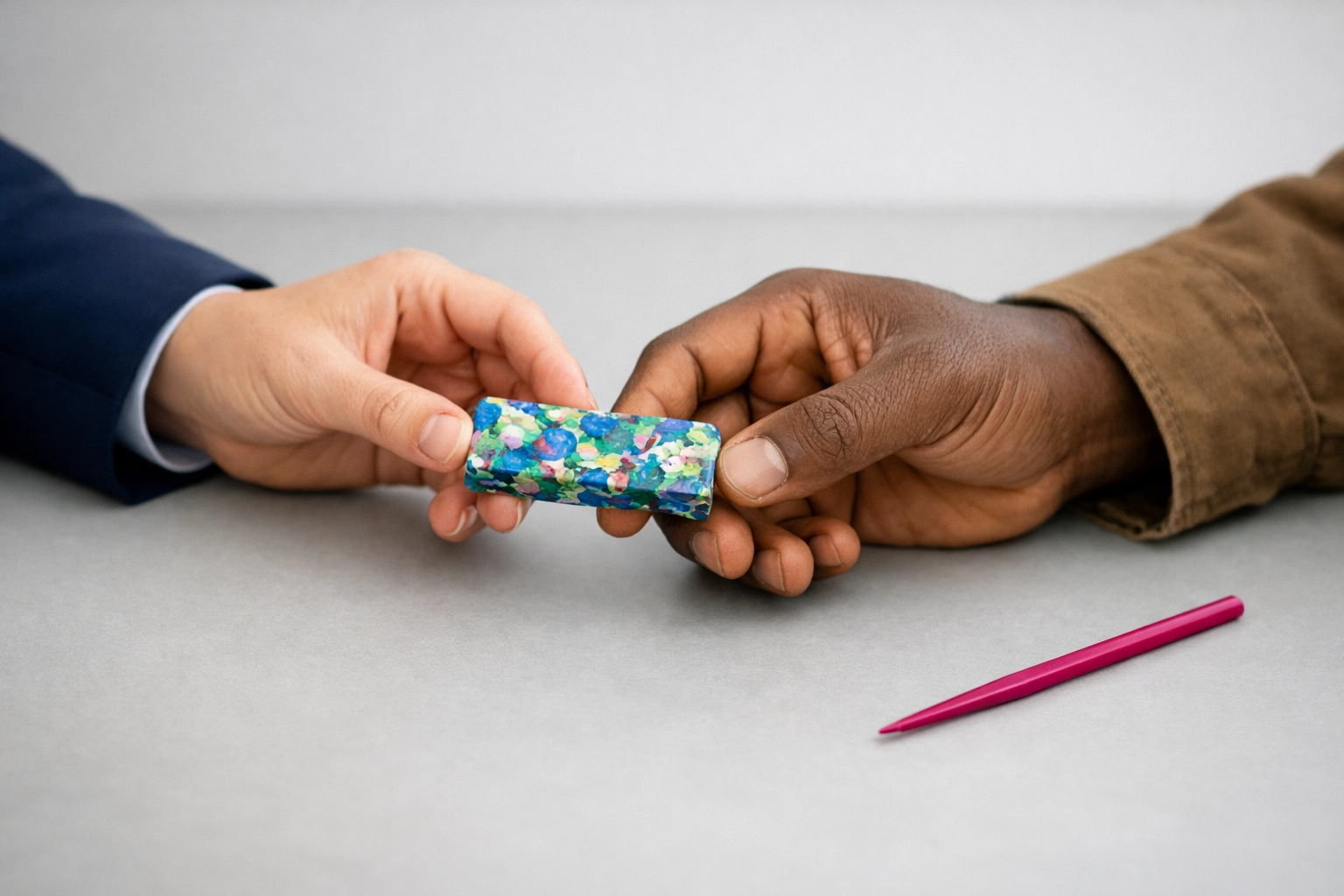
When people think of a SIM card, they think of that tiny little chip in their phone. But in a retail environment, a SIM card comes wrapped in a lot of "stuff." We’re talking:
- Plastic retail hangers.
- Cardboard and paper instructions.
- Australia Post plastic satchels.
- The plastic "credit card" size carrier that holds the SIM.
When you multiply that by 3 million, you aren't just looking at a box of cards; you’re looking at pallets upon pallets of mixed-material waste.
This is where most traditional recycling programmes fail. A standard kerbside bin can’t handle this. Even most industrial recyclers find it too "fiddly" because the materials are so tightly integrated. If you want to achieve a truly recycled plastic circular economy, you have to get your hands dirty.
The Process: Dismantling and Segregation
The magic happened at Mai Wel. The team there received the cards in their original retail packaging. To recycle these properly, every single unit had to be dismantled by hand.
The process was broken down into a high-efficiency line:
- Opening: Removing the product from the Australia Post satchels.
- Stripping: Separating the paper and cardboard manuals from the plastic housing.
- Segregation: Sorting the metals (the actual chips), the paper, and the various types of plastic.
This meticulous work is exactly what social procurement is designed for. It provided the Mai Wel team with repetitive, engaging, and manageable tasks that contributed to a massive national goal.
"Seeing the pride the team at Mai Wel took in processing these cards was a highlight for us. It’s a reminder that the circular economy isn’t just about machines: it’s about community." : Jess Hodge, CEO
Resourceful Living’s Role: Turning "Waste" into Value
Once Mai Wel had done the heavy lifting of segregation, the plastic components were sent to us at Resourceful Living.
Our job was to take the SIM cards, the Aus Post bags, and the original plastic packaging and turn them into something that would never see a landfill. This is what we call closed-loop manufacturing in Australia.
Our technical approach included:
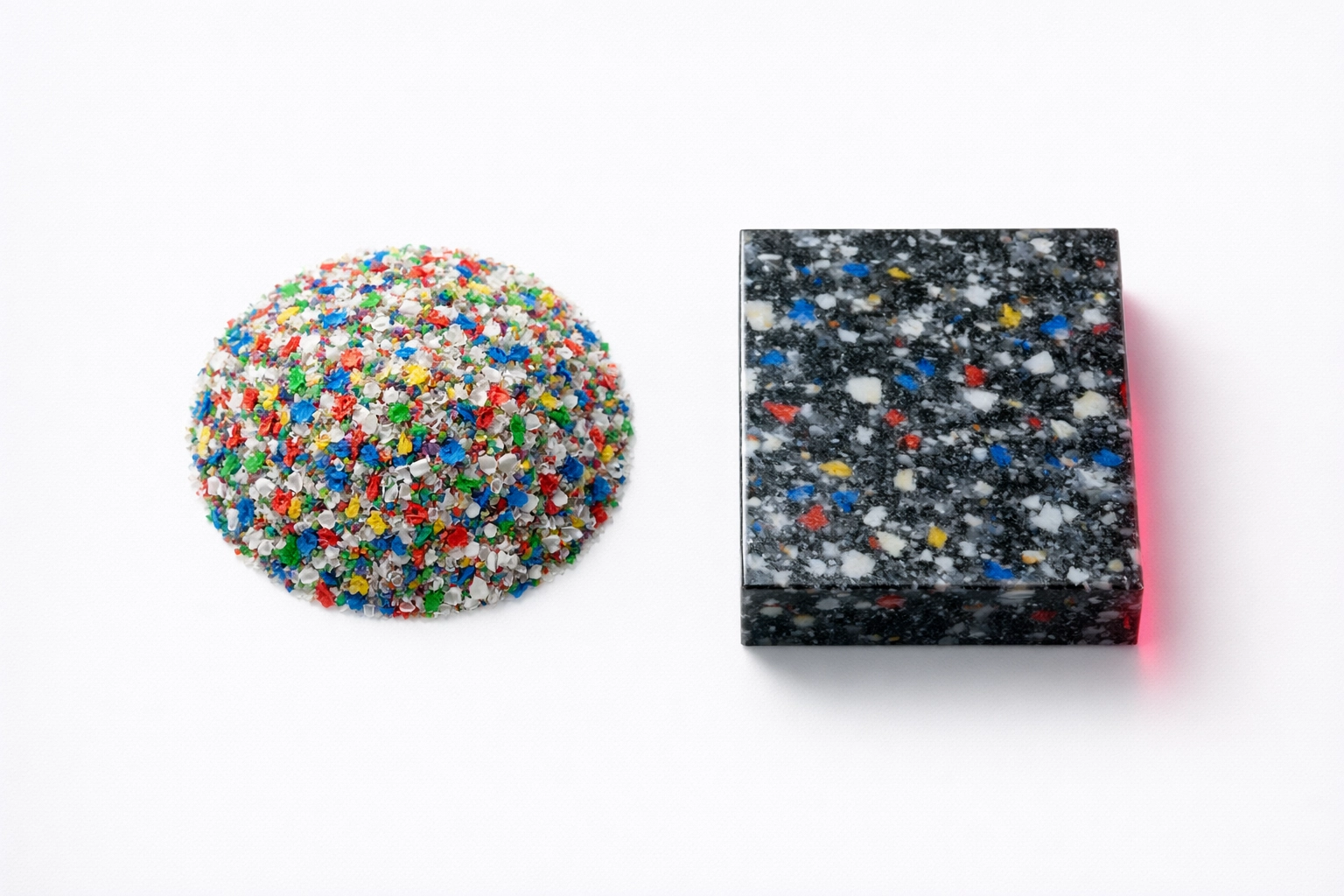
- Granulation: We shredded the mixed plastics into small flakes.
- Cleaning: Removing any residual adhesives or contaminants.
- Melting and Pressing: Using our proprietary heat and pressure process to turn those flakes into solid, industrial-grade panels.
Because we were dealing with high-quality plastics from Telstra, the resulting panels were incredibly durable. We can use these panels to create anything from furniture to recycled plastic products for mining sites.
Why Collaboration is the Secret Sauce
This project succeeded because no one tried to do it alone.
- Telstra provided the volume and the commitment to ESG.
- Mai Wel provided the skilled labour and social heart.
- Black Dog assisted in the logistics and partnership management.
- Resourceful Living provided the end-of-life manufacturing solution.
If Telstra had just sent these to a massive waste-to-energy plant, the materials would have been lost forever. By working with us, they ensured that the carbon footprint of the original plastic was "locked away" in new products, effectively reducing landfill costs with circular procurement.
The Environmental Impact by the Numbers
While we love the social side, we also love the data. Here’s a snapshot of what 3 million SIM cards represents:
| Material Type | Outcome |
|---|---|
| Plastic (HDPE/LDPE/PVC) | Processed into furniture and industrial panels |
| Paper & Cardboard | Sent to traditional pulp recycling |
| Metal (Chips) | Specialized recovery for precious metals |
| Landfill Diversion | 100% of the primary components |
By choosing to recycle rather than discard, this project saved a significant amount of CO2 emissions. Manufacturing from recycled plastic uses roughly 80% less energy than creating "virgin" plastic from oil.
For businesses looking to improve their sustainability reporting, this is the kind of data that makes a real difference. If you're wondering how your own business stacks up, we always recommend starting with a waste audit.

Lessons for Other Businesses
If you’re a procurement manager or a business owner, you might be thinking, "This is great for Telstra, but what about me?"
The reality is that almost every business has a "SIM card equivalent": a waste stream that feels too hard or too messy to recycle. Whether it’s old uniforms, outdated point-of-sale displays, or packaging, there is almost always a way to keep those materials in the loop.
Key Takeaways:
- Don’t fear the "Fiddly": If a waste stream is hard to separate, look for a social enterprise partner. They are often better equipped for manual sorting than big industrial plants.
- Think Beyond the Bin: Traditional waste contracts are designed to make things "go away." Circular partnerships are designed to make things "come back."
- Verify the End Life: It’s one thing to say something is "recyclable." It’s another to know it was transformed into a specific product.
The Future of the SIM Card Plastic
So, where are those 3 million SIM cards now? They aren't in a hole in the ground. They’ve been transformed into 100% recycled plastic panels.
These panels are now being used to create long-life infrastructure. They won't rot, they won't rust, and they don't need painting. They represent a shift in how we view "waste": not as a liability, but as a resource waiting for a second chance.
If you're interested in how these panels are made, you can check out the lifecycle of a recycled plastic panel on our site.

Ready to Start Your Own Circular Journey?
This Telstra project is a blueprint for what’s possible in Australia. It proves that we have the technology, the talent, and the social heart to lead the world in circular manufacturing.
If your organisation is sitting on a waste problem: or if you're looking to integrate more sustainable materials into your next project: let's chat. Whether you need recycled plastic wheel stops or custom-built furniture, we're here to help you make the switch.
The circular economy isn't a pipe dream. It’s happening right now, one SIM card at a time.
Want to learn more?
- Explore our Closed Loop ESG Partner Program.
- Download our guide on how to choose the right thickness for your recycled panels.
- See how we're helping the building industry combat plastic pollution.