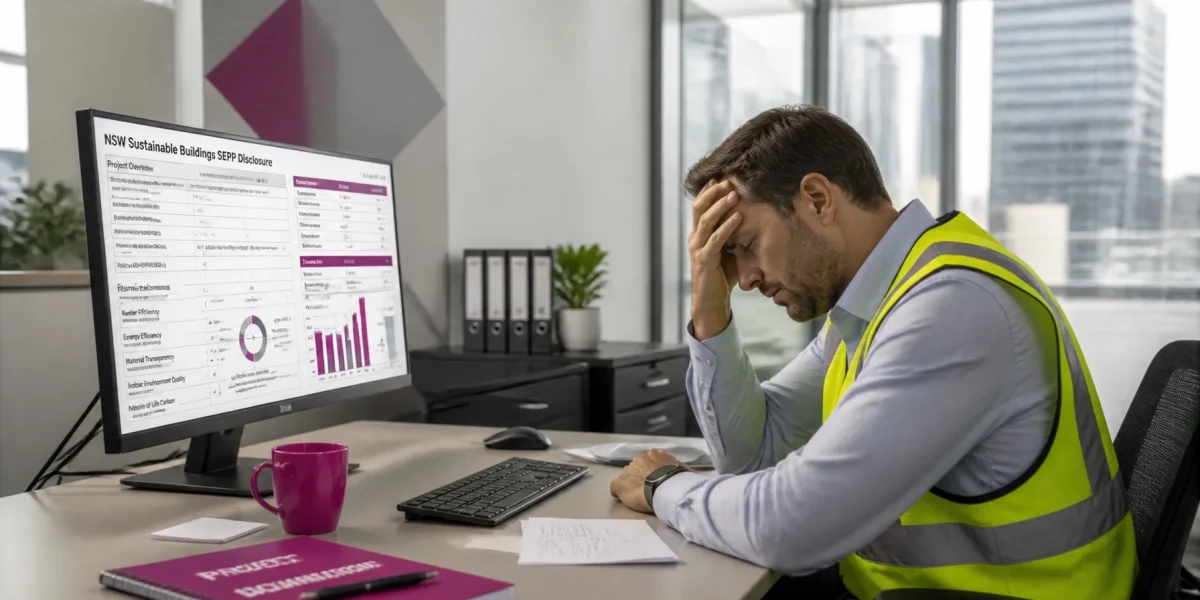
If you’re working in the Australian built environment right now, you know that circular construction 2026 isn't just a buzzword: it’s a regulatory reality. The NSW Sustainable Buildings SEPP (State Environmental Planning Policy) has fundamentally changed how we report the environmental impact of our projects.
However, as we hit the middle of 2026, many builders and developers are still getting caught out. With the release of the March 2026 technical note, the standards for sustainable building materials in Australia have tightened, shifting the focus from "ticking a box" to proving actual decarbonisation.
Is your DA (Development Application) or CC (Construction Certificate) at risk of stalling? Here are the seven most common mistakes we see with SEPP disclosures and exactly how to fix them.
1. Misunderstanding the Disclosure Thresholds (The "Scope" Trap)
One of the biggest pitfalls is assuming the SEPP only applies to massive commercial towers. Many project managers are still operating on outdated 2024 assumptions.
The Mistake: Thinking your small-scale residential renovation or medium-sized commercial fit-out is exempt.
The Reality:
- All new residential builds are now in scope.
- Residential major renovations over $50,000 require disclosure.
- Non-residential new builds with a capital investment value (CIV) over $5 million.
- Non-residential major renovations over $10 million.
The Fix: Audit your project's CIV early. If you’re over the limit, your embodied carbon reporting needs to be integrated into the design phase, not added as an afterthought.
2. Using "Generic" or Global EPDs for Local Projects
In 2026, the NSW Department of Planning is looking for precision. A common error is using European or generic global Environmental Product Declarations (EPDs) for materials sourced or manufactured in Australia.
The Mistake: Using a German EPD for a plastic panel because it "looks similar" to what you’re using on-site.
The Reality: Global data often underestimates transport emissions (A4) and ignores the specific energy mix of Australian manufacturing. Using the wrong data can lead to incorrect carbon mapping, which may result in your submission being rejected or requiring a costly revision.
The Fix: Prioritise suppliers that provide Australian-made EPDs. At Resourceful Living, we provide 100% traceable data for our recycled plastic panels, ensuring your A1–A3 (cradle-to-gate) emissions are accurate and locally verified.

3. Omitting the "Small" Items (Finishes and Substructure)
The March 2026 technical note clarified that embodied carbon isn't just about the concrete slab and the steel frame. It’s now increasingly focused on the building envelope and internal finishes.
The Mistake: Forgetting to include floor finishes, wall linings, and secondary structural elements like lift shafts or stair cores in your BoQ (Bill of Quantities).
The Reality: High-turnover materials: like internal fit-outs and retail displays: can have a massive cumulative impact on a building’s lifecycle emissions. These are often the easiest areas to swap for low-carbon recycled alternatives.
The Fix: Map every line in your BoQ to the NABERS Embodied Carbon categories. If you are using timber or plywood for temporary works or internal linings, consider swapping them for 100% recycled plastic sheets which offer a lower carbon footprint and higher durability.
4. Ignoring "Demonstrated Decarbonisation" Requirements
This is the "new" hurdle introduced in the March 2026 technical update. It’s no longer enough to just report the numbers; you now have to explain them.
The Mistake: Providing a spreadsheet of CO2-e values without a supporting narrative.
The Reality: Consent authorities now require a narrative of design decisions. You must identify specific choices made to reduce upfront carbon. If you didn't choose the low-carbon option, you may need to justify why (e.g., cost, structural necessity, or availability).
The Fix: Include a "Decarbonisation Statement" in your submission. Highlight where you swapped virgin materials for Australian recycled plastic. This proactive approach shows you are meeting the spirit of the SEPP, not just the technical minimum.

5. Treating the CC Disclosure as a "Copy-Paste" of the DA
The NSW Sustainable Buildings SEPP requires disclosure at both the DA stage and the Construction Certificate (CC) stage.
The Mistake: Submitting the exact same carbon report for both.
The Reality: Projects change between planning and construction. Materials get substituted, structural spans are rationalised, and value engineering occurs. If your as-built materials differ significantly from your DA disclosure, you could face compliance issues during final certification.
The Fix: Treat the CC submission as a fresh audit. Use the final procurement list. This is also your last chance to "fix" a high-carbon DA by specifying materials like Resourceful Living's 100% recycled sheets to bring your total project impact down.
6. Boundary Blunders: A1–A3 vs. Whole-of-Life
Confusion over lifecycle stages is a leading cause of data inconsistency in SEPP submissions.
The Mistake: Lumping A4 (transport) and A5 (construction installation) emissions into your primary A1–A3 reporting figures without clear delineation.
The Reality: The current NSW framework focuses primarily on A1–A3 ("cradle-to-gate") emissions. While reporting further stages is encouraged for Green Star or NABERS ratings, for SEPP disclosure, the boundaries must be explicitly clear.
The Fix: Standardise your reporting to the A1–A3 boundary first. Use high-quality data that accounts for raw material extraction and manufacturing. By using locally sourced materials, your A1-A3 values are naturally lower because the "cradle" is right here in Australia.
7. Zero Strategy for Circularity (End-of-Life)
While the SEPP currently focuses on "upfront" carbon, the circular construction 2026 shift means that authorities are looking at what happens when the building is eventually decommissioned.
The Mistake: Choosing "sustainable" materials that end up in a landfill because there is no local recycling pathway.
The Reality: If a material can't be recycled at the end of its life, its "circularity" score is zero. Many imported "green" composites are impossible to process in Australia.
The Fix: Implement a Product Stewardship approach. Choose materials with a guaranteed take-back program. Resourceful Living offers a free take-back service for all our products, ensuring they are remanufactured back into new panels: effectively closing the loop for your project.

How to Nail Your Next Disclosure
Meeting the NSW Sustainable Buildings SEPP doesn't have to be a headache. It’s about data accuracy, local traceability, and demonstrated effort.
"The March 2026 technical note isn't just a hurdle: it’s an opportunity for builders to prove they are leading the industry in decarbonisation. Those who master the data now will be the preferred partners for government and Tier 1 tenders for the next decade."
Your 3-Step Compliance Checklist:
- Verify the CIV: Confirm if your project hits the $5M (non-res) or $50k (res reno) threshold.
- Source Local EPDs: Stop relying on international data. Get material data that reflects Australian manufacturing.
- Specify for Circularity: Swap high-carbon virgin materials for 100% recycled alternatives that include a circular take-back program.
Ready to lower your project’s upfront carbon? Download our Specifier’s Technical Guide or chat with our team about how our Australian-made recycled panels can help you ace your next SEPP disclosure.