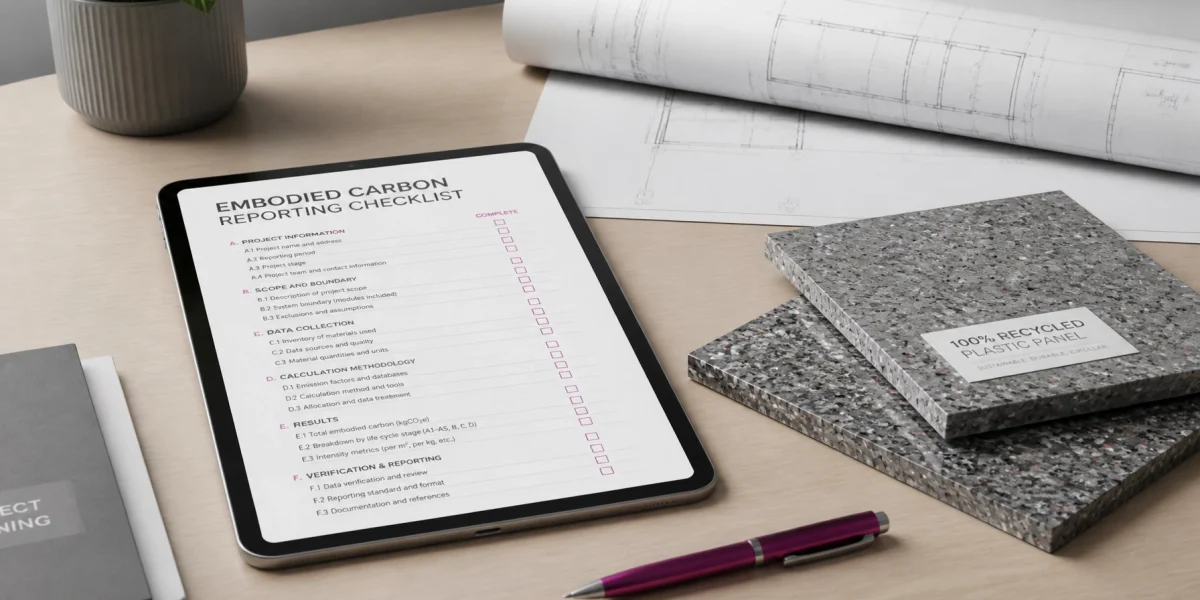
Download this checklist and keep it on your desk for every 2026 tender submission. In the evolving landscape of Australian construction, being "tender-ready" now means being "carbon-ready."
By 2026, embodied carbon reporting is no longer a voluntary "nice-to-have" for high-end projects. With the full implementation of the NSW Sustainable Buildings SEPP, updates to NCC 2025, and the mandatory rollout of NABERS Embodied Carbon ratings, builders and specifiers face a new reality: if you can't measure it, you won't win the work.
This guide provides a professional, step-by-step framework to ensure your project documentation meets the rigorous standards required for modern Australian tenders.
Section 1: Why Embodied Carbon Reporting Matters Now
The Australian built environment is undergoing a rapid transition. Historically, the focus was on operational carbon (the energy used to run a building). However, as our grid decarbonises, the focus has shifted toward embodied carbon: the emissions generated during the manufacturing, transport, and construction of building materials.
Key 2026 Drivers:
- NSW SB SEPP: Requires embodied emissions reporting for all new residential and non-residential developments via the Planning Portal.
- NABERS Embodied Carbon: A mandatory rating system for many commercial and government tenders, requiring verified data for modules A1–A3.
- Scope 3 Requirements: Large construction entities are now legally required to disclose value-chain emissions, making accurate material data a non-negotiable part of procurement.
Failing to provide a detailed embodied carbon reporting checklist in your bid doesn't just hurt the planet; it risks immediate disqualification from government and Tier 1 commercial projects.
Section 2: The A1-A5 Framework Explained
To report accurately, you must understand the A1–A5 life-cycle stages, often referred to as "upfront carbon." This is where the majority of a project's immediate carbon impact resides.
- A1 (Raw Material Supply): Emissions from extracting and processing raw materials.
- A2 (Transport to Manufacturer): The carbon cost of moving raw materials to the factory.
- A3 (Manufacturing): The energy used to turn those materials into a finished product.
- A4 (Transport to Site): Logistics from the factory to your project location.
- A5 (Construction Installation): On-site energy use and waste management during assembly.
For most 2026 tenders, the minimum requirement is reporting on A1–A3. Choosing materials that use 100% Australian recycled waste significantly reduces these stages because the "A1" stage is essentially bypassed: the material is salvaged waste, not virgin resource.
✅ Checklist Item 1: Collect Your Material Data
The foundation of any report is a verified Bill of Quantities (BoQ). You cannot estimate; you must document.
- Identify High-Impact Materials: Focus on the "Big Five": Steel, Concrete, Aluminum, Timber, and Plastics/Finishes.
- Target 80% Coverage: Most reporting frameworks (including NSW Planning) require accounting for at least 80% of materials by total quantity.
- Source EPDs Early: An Environmental Product Declaration (EPD) is your primary source of truth. Ensure your suppliers provide EPDs that are current and third-party verified.
- Verify Units: Ensure all data is collected in consistent units (tonnes, m², or m³) as required by the NABERS Embodied Carbon Tool.

Section 3: Calculate Your Upfront Carbon
Once data is collected, it must be processed through a recognised calculator. In Australia, the NABERS Embodied Carbon Calculator (launching in full Feb 2026) is the industry benchmark.
✅ Checklist Item 2: Calculate Your Upfront Carbon
- Apply Emission Factors: Match your material quantities against the Global Warming Potential (GWP) figures found in your supplier's EPDs.
- Calculate A4 Transport: For the A4 stage, document the manufacturing location. Local Australian manufacturing inherently scores higher (lower carbon) than imported materials due to reduced shipping distances.
- Account for Waste Factors: Include a percentage for on-site waste. Using pre-cut or custom-sized recycled panels can reduce this figure significantly.
- Certification: Ensure your calculations are reviewed or certified by a Quantity Surveyor (QS), engineer, or accredited NABERS assessor.
Section 4: Verify Your Supply Chain
Transparency is the enemy of greenwashing. In 2026, "trust us, it's green" is not a valid submission. Tenders now employ an "If Not, Why Not" framework: meaning you must justify why a low-carbon or recycled alternative wasn't chosen.
✅ Checklist Item 3: Verify Your Supply Chain
- Check Local Content: Does the material support the Australian circular economy? Using 100% Australian plastic waste directly helps you meet local sourcing targets.
- Traceability Audit: Can the supplier trace their raw material source? Resourceful Living manages the end-to-end cycle, providing a clear chain of custody from waste collection to the final panel.
- Check Performance Testing: Ensure the low-carbon alternative doesn't compromise safety. Materials must be tested for strength, durability, and weather resistance.
- Compare Against Plywood: Many builders are finding that traditional materials like plywood are costing more in the long run when carbon penalties and replacement cycles are factored in.

Section 5: Document Your Take-Back Plan
A major component of 2026 reporting is the End-of-Life (Module C) and Circular Economy potential (Module D). Tenders now favour products that aren't destined for landfill.
✅ Checklist Item 4: Document Your Take-Back Plan
- Verify Recyclability: Is the material 100% recyclable at the end of its life, or is it a composite that will end up in landfill?
- Identify Take-Back Programs: Does the manufacturer offer a formal take-back scheme?
- Include Take-Back in Submission: Explicitly state that materials like Resourceful Living panels will be collected free of charge at the end of their life for remanufacturing. This turns a future waste liability into a circular asset on your report.
- Quantify Waste Diversion: Estimate the tonnage of plastic waste diverted from landfill by choosing recycled products instead of virgin alternatives.
Section 6: Submit with Confidence
The final step is the narrative. How do you present this data to the client to show you are a forward-thinking, low-risk partner?
✅ Checklist Item 5: Submit with Confidence
- Summarise Reductions: Provide a clear "Carbon Savings" summary (e.g., "This project achieved a 22% reduction in upfront carbon compared to the reference design").
- Include Supporting Evidence: Attach all EPDs and manufacturer certificates as an appendix.
- Align with Client Goals: Reference the client's own Net Zero or sustainability targets in your cover letter.
- Commit to Monitoring: State that you will provide an "As-Built" embodied carbon report upon practical completion to verify the tender promises.

Quick Reference: Low-Carbon Material Substitutions
Use this table to identify quick wins for your next 2026 tender submission.
| Traditional Material | Low-Carbon Alternative | Carbon Benefit | Circular Benefit |
|---|---|---|---|
| Virgin Plastic/Acrylic | 100% Recycled HDPE Panels | Up to 80% reduction in A1-A3 | 100% Australian waste diversion |
| Formwork Plywood | Recycled Plastic Sheeting | Reusable and durable | Zero rot/delamination; 100% recyclable |
| Imported Furniture | Bespoke Recycled Furniture | Massive reduction in A4 transport | Locally manufactured in Australia |
| Standard Concrete | Low-Carbon / Geopolymer | Significant A1 reduction | Use of fly-ash/slag industrial by-products |
The Bottom Line for 2026 Tenders
Embodied carbon reporting is the new metric for success in the Australian built environment. By utilizing this checklist and prioritizing materials that are 100% recycled and Australian-made, you don't just comply with regulations: you lead the market.
Ready to specify high-performance, low-carbon materials for your next project?
Download our full Material Technical Data Sheets or contact our team to request a sample for your 2026 tender library.