The landscape of Australian construction has shifted. As of June 2026, the NABERS Embodied Carbon tool has become the primary yardstick for measuring building performance. Architects, builders, and developers are no longer just reporting operational energy; they’re being audited on the upfront carbon baked into every panel, beam, and bollard.
If you’re managing a Bill of Quantities (BoQ) today, you’re likely staring at three main contenders for your next project: traditional concrete, renewable engineered bamboo, and 100% recycled plastic.
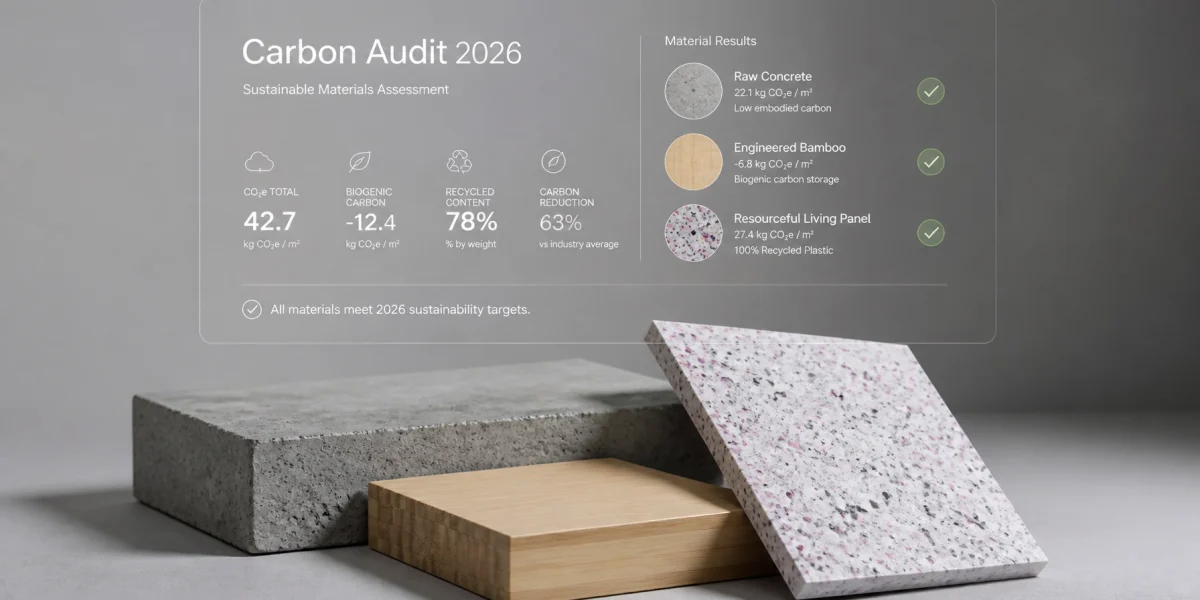
While concrete remains the structural default, the 2026 Carbon Audit metrics are forcing a re-evaluation. Is the carbon cost of concrete still justifiable? Does engineered bamboo live up to its "green" reputation when resins are involved? And how does recycled plastic vs concrete structural performance stack up in non-traditional applications?
Let’s break down the data.
1. The Heavyweight: Concrete’s Carbon Crisis
Concrete is the single largest contributor to embodied carbon in the built environment. For a typical Australian commercial project, concrete and steel account for roughly 43% of upfront emissions.
Under the new NABERS v2.1 framework, auditors are setting "not-to-exceed" targets. For 20 MPa concrete, the goal is now ≤ 200 kg CO₂-e/m³. Most standard mixes still sit closer to 400 kg CO₂-e/m³, meaning if you specify traditional concrete without high-performance SCMs (Supplementary Cementitious Materials), your project’s carbon score will likely fail the audit.
"The bulk mass of concrete usually dominates a building's embodied carbon total. Reducing this intensity is no longer optional; it’s a compliance necessity." : Industry Insight
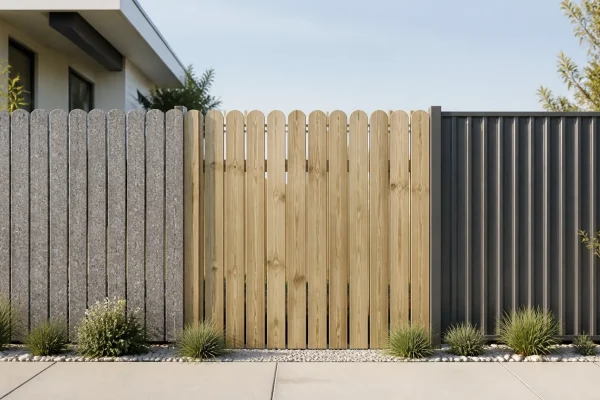
While innovations in geopolymer concrete are promising, the sheer volume required for noise barriers, retail plinths, and erosion control often makes it a "carbon anchor" in your report. This is where recycled plastic vs concrete structural comparisons become critical for low-load applications.

2. The Challenger: Engineered Bamboo’s Carbon Audit
Engineered bamboo has long been the "darling" of sustainable design. Because it’s a rapidly renewable grass that sequesters carbon during growth, it often shows net-negative upfront carbon in cradle-to-gate LCAs.
However, a 2026 engineered bamboo carbon audit reveals hidden complexities:
- Resin Intensity: Most engineered bamboo requires high volumes of phenol-formaldehyde or isocyanate resins to bond the fibres. These resins carry a high chemical carbon load.
- Transport Emissions: While Australia is beginning to grow its own, the majority of industrial-scale engineered bamboo is still imported from Asia, adding significant Module A2 transport emissions to the NABERS score.
- End-of-Life Issues: Once bamboo is impregnated with synthetic resins, it cannot be easily composted or recycled. In an audit focusing on circularity, bamboo often loses points because it eventually ends up in landfill.
3. The Game-Changer: 100% Recycled Plastic
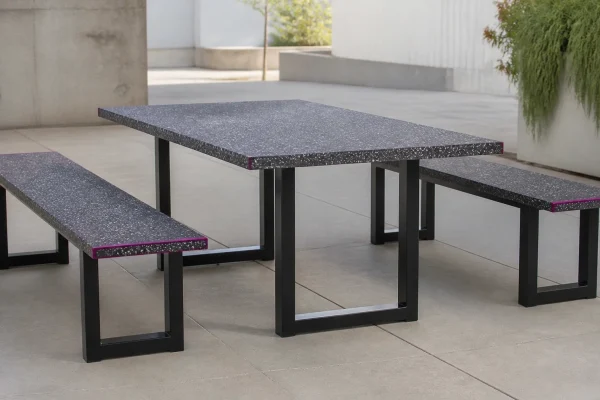
At Resourceful Living, we’ve seen a massive surge in demand as builders realise that 100% recycled HDPE and LDPE offer a "quick win" for carbon audits. Unlike bamboo or concrete, our panels are solid blocks of recycled material: no additives, no veneers, and no resins.
Why Recycled Plastic Wins the 2026 Audit:
- Zero Raw Extraction: We use 100% Australian post-consumer plastic waste. This avoids the massive energy spend required for virgin plastic production or cement kiln operation.
- Ultra-Low Manufacturing Energy: It takes significantly less energy to remanufacture 1 tonne of plastic into a 2400mm x 1200mm panel than it does to harvest, process, and resin-bond bamboo.
- The Circular Trump Card: Our Take-Back Program allows us to collect products at their end-of-life and remanufacture them again. This provides a verified "closed-loop" credit that auditors love.

4. Performance Face-Off: More Than Just Carbon
A carbon audit isn't the only metric that matters. For architects and builders, durability and maintenance determine the long-term ROI of a material.
Moisture Resistance 💧
- Concrete: Porous. Requires sealing and is prone to cracking and spalling over time, especially in coastal or high-moisture environments.
- Engineered Bamboo: Highly susceptible to moisture. Even with high-tech resins, bamboo can swell, delaminate, or rot if used in wet areas like bathrooms or for external erosion control.
- Recycled Plastic: 100% waterproof. Our material is chemically inert. It won't rot, swell, or host mould, making it the superior choice for kitchen and bathroom renovations and retail fit-outs.
Maintenance and Lifespan 🛠️
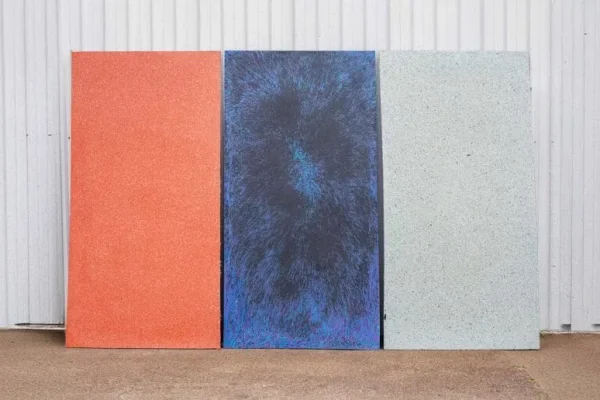
Concrete requires structural inspections. Bamboo requires sanding and re-coating. Resourceful Living recycled plastic is effectively maintenance-free. It’s UV-stabilised and the colour goes all the way through the material, so scratches don't reveal a different-coloured core.

The 2026 Comparison Table
| Metric | Conventional Concrete | Engineered Bamboo | Recycled Plastic (RL) |
|---|---|---|---|
| Embodied Carbon | High (400kg+ CO₂-e/m³) | Low (Net-negative growth) | Ultra-Low (Recycled content) |
| Moisture Resistance | Moderate (Requires seal) | Low (Swells/Rots) | High (100% Waterproof) |
| End-of-Life | Downcycled (Road base) | Landfill (Due to resins) | 100% Recyclable (Closed-loop) |
| Local Sourcing | High | Low (Mostly Imports) | High (100% Australian) |
| Installation Speed | Slow (Curing time) | Moderate | Fast (Standard wood tools) |

The Verdict: Which Wins the Audit?
If you are building a multi-storey structural core, concrete is still your only option: but you must use low-carbon mix designs to pass the 2026 audit.
If you are looking for aesthetic wall linings in dry, low-traffic areas, engineered bamboo offers a beautiful, renewable look, though you’ll need to account for the resin-related emissions in your reporting.
However, for the highest possible Carbon Audit score, 100% recycled plastic is the clear winner.
By substituting concrete or bamboo with our panels for retail displays, kitchen carcasses, noise barriers, and storage solutions, you are:
- Abating up to 23% of upfront emissions through simple material substitution.
- Supporting local Australian recycling infrastructure.
- Securing a "Take-Back" guarantee that removes the headache of future waste management.

Your 2026 Action Plan
Don't let a carbon audit catch you off guard. Follow these three steps to optimise your next tender:
- Request an EPD: Always ask for an Environmental Product Declaration (EPD) for your materials. We provide verified data to make your NABERS reporting seamless.
- Audit Your Non-Structural Elements: Look at your Bill of Quantities. Can those plinths be recycled plastic instead of concrete? Can that joinery be 100% recycled HDPE instead of MDF or bamboo?
- Specify Circularity: Mention "Take-Back Programs" in your tender documents. It signals to clients that you are thinking about the building's impact 50 years from now.
Ready to boost your project’s carbon score?
Contact the Resourceful Living team today to order material samples or get a quote for our custom 2400mm x 1200mm panels.