In 2026, the cost of "getting it wrong" with sustainability claims has never been higher. For procurement officers, specifiers, and project managers in the Australian built environment, greenwashing is no longer just a PR risk: it's a massive legal and financial liability.
With the ACCC’s 2026 enforcement priorities now in full swing, companies making unsubstantiated claims about "recycled content" or "sustainable sourcing" are facing record-breaking penalties. But beyond the fines, there’s a deeper issue: the traceability gap.
If you can't prove exactly where your material came from, how it was processed, and who handled it, your supply chain isn't just "green": it's a gamble. This guide will walk you through how to cut through the "sustaina-babble" and verify the true provenance of your recycled materials.
The High Cost of "Vague" (The 2026 Regulatory Reality) ⚖️
The Australian Consumer Law (ACL) has shifted gears. As of March 28, 2026, the maximum corporate penalty for misleading environmental claims has skyrocketed. The ACCC and ASIC are no longer just looking for outright lies; they are targeting vague, unqualified, and broad claims.
Terms like "eco-friendly," "green," and even "sustainably sourced" are now major red flags unless they are backed by specific, accessible, and independent evidence. For B2B procurement, this means you can't just take a supplier's word for it. You need a paper trail that stands up to a federal audit.
"Regulators are now focusing not only on what businesses say but also on what they do: including governance, compliance systems, and execution of sustainability commitments." : ACCC Guidance Summary, 2026.
If your project relies on sustainable building materials in Australia, the burden of proof is on you to ensure your suppliers aren't just shifting waste from one part of the world to another under the guise of "recycling."
Provenance vs. Promises: The Traceability Gap 🔍
The biggest challenge in the recycled plastic industry is the globalized supply chain. Many "recycled" products sold in Australia are manufactured overseas using "mixed plastic" from unknown sources.
When a product's journey involves multiple border crossings and third-party aggregators, the provenance (the place of origin) becomes a black box. This is where greenwashing thrives.
Why Global Chains Struggle with Traceability:
- Contamination Risks: Mixed plastics from multiple countries often contain additives or non-recyclable polymers that compromise structural integrity.
- Carbon Leakage: Shipping waste thousands of kilometres to be processed and then shipping it back as a "green" product often offsets the carbon savings of using recycled material in the first place.
- Verification Difficulty: Auditing a facility in another hemisphere is expensive and often impossible, making it easy for suppliers to provide "generic" certifications that don't match the specific batch you receive.
At Resourceful Living, we solve this by keeping the entire loop 100% Australian. We don't just "source" material; we manage the entire recycling and manufacturing cycle right here in our local facility.
The 3 Pillars of Material Verification ✅
To ensure your supply chain is bulletproof, you need to demand documentation that covers these three critical areas:
1. Provenance Documentation (Source Tracking)
True traceability starts at the bin. You should be able to ask your supplier: "Where exactly was this plastic collected?"
- The Standard: Evidence of collection from Australian municipal or industrial waste streams.
- The Greenwash: Vague claims like "ocean-bound plastic" or "post-consumer waste" without a specific regional origin.
2. Batch-Level Tracking
A "company-wide" sustainability certificate is not enough. For high-value asset strategies, you need batch-level transparency.
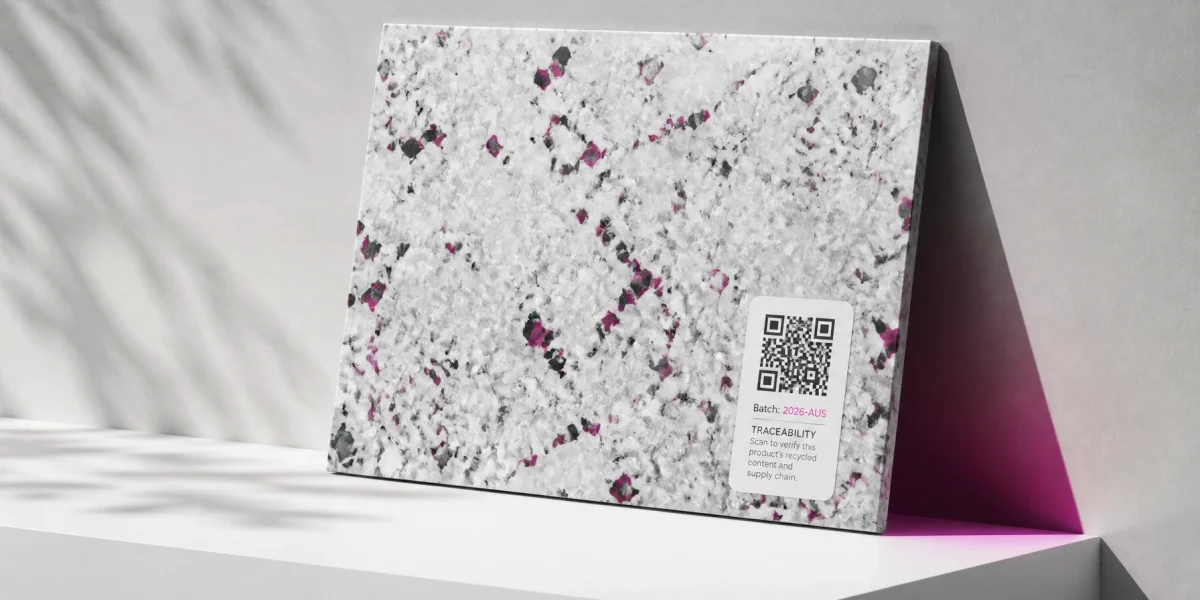
- The Standard: Every panel or product has a batch number that links directly to a specific production run and material source.
- The Greenwash: Reusing the same "recycled content" declaration for years without updating it for new production runs.
3. Third-Party Testing for Performance
Recycled doesn't mean "second-rate." If the material is used in construction or infrastructure, it must be tested for strength, UV resistance, and durability.
- The Standard: Independent lab results verifying that the 100% recycled material meets or exceeds the specs of traditional materials like timber or concrete.
- The Greenwash: Using data sheets from "virgin" materials to represent recycled products.
Red Flags: Spotting Greenwashing in Your Tenders 🚩
When reviewing submissions for your next project, watch out for these common "sustaina-babble" tactics:
- "Recyclable" vs. "Recycled": A product made of 100% virgin plastic is often labelled "100% recyclable." This is technically true but intentionally misleading if you are looking for recycled content.
- Hidden Additives: Many "recycled panels" use veneers or virgin plastic outer layers to hide a poor-quality core. At Resourceful Living, our recycled plastic sheets are solid blocks of 100% recycled plastic: no additives, no veneers, no fillers.
- No "Take-Back" Program: A truly circular product must have an end-of-life plan. If a supplier won't take their product back to be remanufactured, they aren't part of a circular economy; they are just delaying the trip to the landfill.
- Vague Percentages: Claims like "made with recycled materials" usually mean the percentage is so low they're embarrassed to print it. Always demand the exact percentage of post-consumer waste.

The Resourceful Living Standard: End-to-End Transparency 🔄
We believe that transparency is the new currency of sustainability. Our business model is built on a "closed-loop" philosophy that eliminates the traceability gap entirely.
- Local Sourcing: We only use 100% Australian plastic waste. This supports the local economy and ensures we know exactly what is going into our extruders.
- Direct Control: Because we manage the sorting, shredding, and manufacturing in-house, we can provide clients with a direct line of sight from the raw waste to the finished recycled plastic furniture or panels.
- Verified Durability: Our materials are engineered for the harsh Australian climate. We don't just claim they last; we've tested them to ensure they handle the UV and structural loads of coastal construction.
- Take-Back Program: We collect our products free of charge at the end of their life to be turned back into new panels, ensuring your project remains zero-waste.

Procurement Checklist: Verifying Your Suppliers 📋
Use this checklist during your next tender evaluation to ensure your recycled material claims will stand up to ACCC scrutiny.
| Verification Step | What to Ask / Look For | Status |
|---|---|---|
| Material Origin | Can the supplier provide the specific Australian region/facility where waste was sourced? | ☐ |
| Manufacturing Location | Is the product manufactured in Australia, or is it an import with a "local" label? | ☐ |
| Percentage Transparency | Does the documentation state the exact % of post-consumer vs. pre-consumer recycled content? | ☐ |
| Batch Tracking | Is there a physical batch number on the product that links to production records? | ☐ |
| Performance Data | Are there independent test reports for UV stability, tensile strength, and water absorption? | ☐ |
| Circular Commitment | Is there a written "Take-Back" agreement for the end of the product's life? | ☐ |
| Carbon Reporting | Can the supplier provide embodied carbon data for the specific material? | ☐ |
Future-Proofing Your Next Project 🚀
The shift toward a circular economy isn't just a trend; it's a fundamental change in how we build. By demanding traceability today, you are protecting your organisation from the legal risks of greenwashing and ensuring your project delivers genuine environmental value.
If you’re ready to switch to a material that is 100% Australian, 100% recycled, and 100% traceable, we're here to help. Whether you need standard 2400mm x 1200mm panels or a bespoke solution for a retail fit-out, we provide the data you need to spec with confidence.
Don't risk your reputation on a "vague" supply chain. Let’s build something that’s actually sustainable.