The landscape for Australian construction is shifting. With Green Star v1.1 becoming mandatory for all new ratings from May 2026, the focus has moved from "energy efficiency" to a much more rigorous metric: Upfront Carbon.
If you're an architect, builder, or specifier, you've likely realised that traditional materials are making it harder to hit those tighter targets. To achieve a 5 or 6-star rating under the new framework, projects must now demonstrate a minimum 10% reduction in upfront carbon emissions compared to a reference building.
But here’s the good news: achieving these points doesn't have to be a technical headache. Swapping out virgin materials for 100% Australian recycled HDPE panels is one of the most effective "quick wins" for your next project.
Here are five specific ways recycled plastic sheets help you earn maximum Green Star points under the v1.1 framework.
1. Smashing the Upfront Carbon Reduction Targets (A1-A5)
Under Green Star v1.1, the Upfront Carbon Reduction credit (Credit 21) is king. It focuses on stages A1 through A5 of a building's lifecycle: raw material supply, transport, and manufacturing.
When you specify 100% recycled plastic sheets, you are essentially "skipping" the most carbon-intensive part of the material lifecycle. Virgin plastic production requires massive energy for petroleum extraction and refining. In contrast, Resourceful Living panels use zero virgin feedstock.
- ✅ The Math: Projects can earn up to 6 points by achieving a ≥40% reduction in upfront carbon.
- ✅ The Advantage: Because our panels are solid blocks of 100% recycled plastic with no additives or veneers, their embodied carbon footprint is significantly lower than traditional composites or treated timbers.
"The shift to v1.1 means we can no longer rely on carbon offsets at the end of a project. We have to design the carbon out from day one by selecting materials that have already done the heavy lifting in a previous life."
2. Navigating the Responsible Products Framework
Green Star v1.1 has introduced the Responsible Products Framework, which rewards products that are transparent, healthy, and ethically sourced. Points are awarded based on a "Responsible Product Score" (RPS).
Our panels help you score high here because they are 100% traceable. We manage the end-to-end recycling and manufacturing cycle right here in Australia. This means we can provide the exact documentation you need to verify the material source: a critical requirement for Credit 19 (Responsible Materials).

3. Boosting Your "Circular Economy" Score
The Circular Economy credit (Credit 25) is no longer a "nice to have." It rewards projects that use materials that can be recovered and reused.
Resourceful Living offers a comprehensive take-back program. At the end of a building's life (or even during a renovation), we collect our products free of charge and feed them back into our manufacturing line to create new sheets.
Why This Matters for Specifiers:
- Design for Disassembly: Our panels are incredibly durable and can be fixed using mechanical fasteners (screws/bolts) rather than toxic adhesives. This aligns perfectly with Green Star’s push for "Design for Disassembly," allowing the panels to be removed and remanufactured without contamination.
- Zero Waste: By choosing a material with a guaranteed end-of-life pathway, you're effectively eliminating that material from the project’s future waste stream.
4. Reducing A4 Emissions via Local Sourcing
A common pitfall in Green Star assessments is the "Transport (A4)" emissions. Importing "sustainable" materials from Europe or Asia often results in a massive carbon spike due to international shipping.
By choosing 100% Australian-made and sourced materials, you drastically reduce the transport leg of the Upfront Carbon calculation. We manufacture locally, turning Australian household waste into architectural-grade sheets.
- Faster Turnaround: We manufacture 1 tonne of plastic per day, ensuring your project stays on schedule.
- Lower Logistical Carbon: Sourcing from NSW or regional hubs means your A4 carbon contribution is a fraction of what it would be for imported timber or composite alternatives.

5. Eliminating Toxic Additives for Indoor Environment Quality (IEQ)
Green Star v1.1 places a heavy emphasis on Healthy Materials (Credit 13). Many traditional interior linings use formaldehydes, VOCs, or resins that off-gas over time, negatively impacting air quality.
Because our HDPE panels are pure recycled plastic, they are:
- VOC-Free: There are no glues or binding agents that release harmful chemicals.
- Inert and Non-Toxic: HDPE is the same material used for milk bottles and food containers. It’s naturally resistant to mould and bacteria, making it an ideal choice for high-moisture areas like bathrooms or retail displays.
Practical Implementation: Your Green Star Checklist
If you're ready to integrate recycled plastic sheets into your next build, use this checklist to ensure you're maximising your points:
- Specify 100% Content: Ensure the specification clearly states "100% recycled and 100% recyclable." Beware of "blends" that include virgin plastic or wood fibres, as these are often impossible to recycle at end-of-life.
- Request the EPD: Ask for the Environmental Product Declaration (EPD). This is the "nutrition label" for carbon that your Green Star consultant will need for their LCA modelling.
- Document the Take-Back: Include the manufacturer's take-back program in your Waste Management Plan.
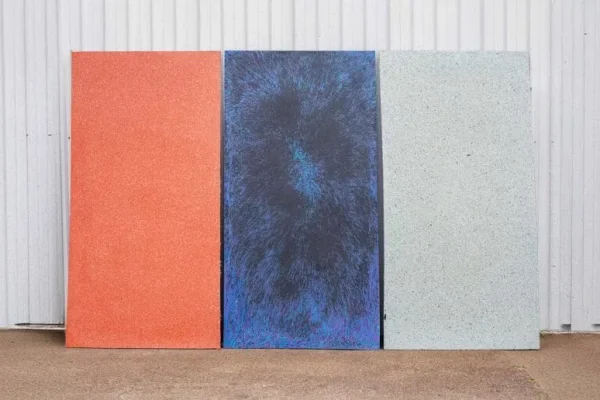
- Optimise Sheet Sizes: Our standard size is 2400mm x 1200mm. Designing with these dimensions in mind reduces off-cut waste during construction.

The Bottom Line
Green Star v1.1 is a challenge, but it's also an opportunity to prove that your project is a leader in the circular economy. By switching to Resourceful Living’s recycled plastic sheets, you aren't just earning points: you're actively diverting Australian waste from landfills and lowering the carbon ceiling of the built environment.
Ready to see how our materials fit into your next project? Learn more about our manufacturing process or explore how we're navigating Australia's new circular construction reforms.
Want to deep-dive into circularity? Check out our guide on why Australian manufacturing is the secret to a true circular economy.