For decades, if you wanted to build something that lasted, you used concrete. It was the "Old Faithful" of the construction industry: heavy, reliable, and seemingly permanent. But as we move further into 2026, the conversation is shifting. We aren’t just asking if a material is "strong" anymore; we’re asking if it’s sustainable, logistically efficient, and truly circular.
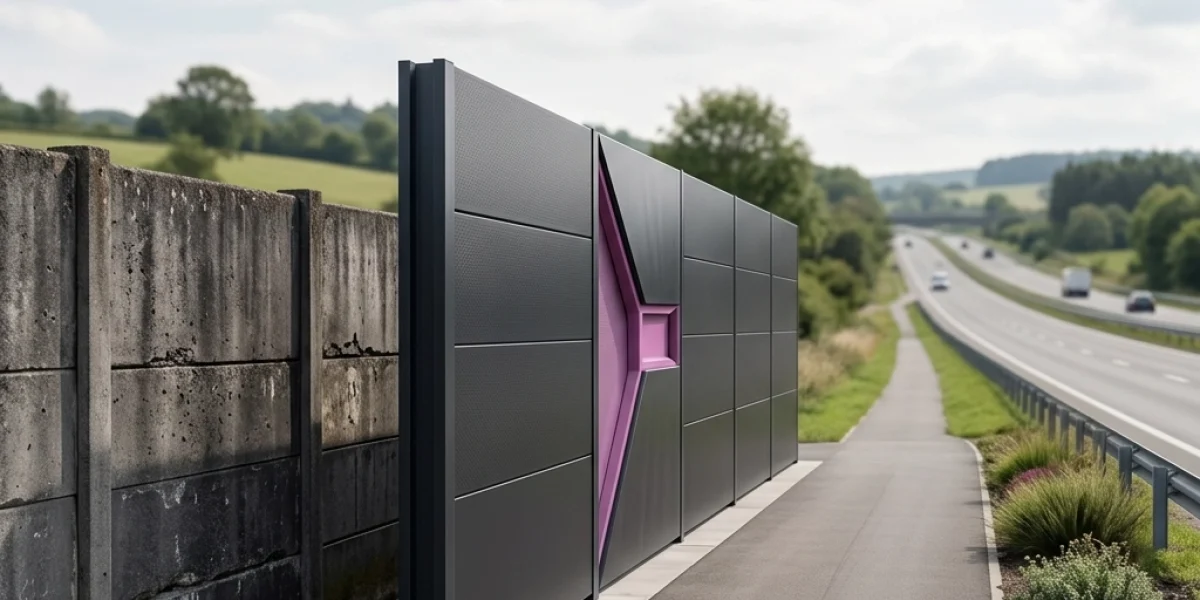
In the world of vertical infrastructure: specifically noise walls: a quiet revolution is happening. The recycled plastic vs concrete structural debate is no longer just a fringe discussion for eco-warriors. It’s a performance-driven battle where recycled plastic is starting to take the lead.
So, is concrete "bad"? Not necessarily. But for specific applications like noise barriers and retaining walls, it’s becoming an increasingly difficult choice to justify. Here is why the industry is pivoting toward sustainable building materials in Australia.
1. The 'Old Faithful' Problem: Carbon Debt and Brittleness
Concrete has two major skeletons in its closet: its massive carbon footprint and its inherent brittleness.
The production of cement (the key ingredient in concrete) is responsible for roughly 8% of global CO2 emissions. In an era where embodied carbon reporting in Australia is becoming a mandatory part of government tenders, concrete is a heavy anchor on a project’s sustainability score. Every cubic metre of traditional concrete comes with a pre-paid "carbon debt" that is nearly impossible to pay off through operational efficiencies later.
Beyond the environmental cost, there’s the material physics. Concrete is incredible under compression, but it is brittle. It doesn't handle vibration or sudden impact well without cracking. Over time, road-side concrete noise walls suffer from hairline fractures caused by ground movement and traffic-borne tremors. These cracks allow moisture to reach the internal steel reinforcement, leading to "concrete cancer" and expensive remediation works.

2. Toughness vs. Strength: Why Plastic Absorbs What Concrete Shatters
When we talk about the recycled plastic vs concrete structural comparison, we need to distinguish between strength and toughness.
- Concrete has high strength: It can hold up a skyscraper.
- Recycled plastic has high toughness: It can absorb energy without failing.
For a noise wall or a safety barrier, toughness is often more valuable than raw compressive strength. High-density recycled plastic panels are ductile. They can flex under wind loads or minor ground shifts and return to their original shape.
While a stray stone or a minor vehicle clip might cause a concrete panel to spall or shatter, a recycled plastic sheet simply absorbs the energy. This impact resistance significantly extends the service life of the infrastructure, often outlasting concrete in high-vibration environments like motorways and rail corridors.

3. The Noise Wall Case Study: Acoustic Performance and Maintenance
A common misconception is that you need the "mass" of concrete to stop sound. While density is important for sound transmission loss, modern engineering has shown that recycled plastic panels can achieve comparable acoustic ratings (often exceeding 30dB reduction) through smart geometric design and layered density.
The Maintenance Factor
This is where the "war" is truly won. Concrete is porous. It sucks up moisture, salt spray, and: most frustratingly for local councils: graffiti.
- Graffiti Removal: Removing spray paint from concrete often requires abrasive blasting or harsh chemicals that further degrade the surface. Recycled plastic is non-porous; graffiti can often be wiped off with simple solvents without damaging the panel.
- Degradation: Concrete crumbles, flakes, and stains over time. Our weather-resistant panels are UV-stabilised and impervious to rot, rust, and salt.
- Aesthetics: Instead of the dull grey of aged concrete, recycled plastic allows for integrated colours and textures that don't fade or peel.
4. Logistics: 1/3 the Weight = 1/2 the Installation Time
In the construction world, weight is money. The logistics of concrete are a nightmare of heavy-haulage permits and massive cranes.
Recycled plastic panels are approximately one-third the weight of their concrete counterparts. This creates a massive ripple effect of savings across the project lifecycle:
- Transport: You can fit three times as many panels on a single truck, slashing transport emissions and fuel costs.
- On-site Handling: Instead of needing a 50-tonne crane to move a single concrete slab, a standard telehandler or even manual handling teams can often position plastic panels.
- Safety: Lower weight means lower risk. If a panel is mishandled, the potential for catastrophic injury or structural damage is significantly reduced.
- Speed: Because the panels are lighter and easier to manoeuvre, installation teams can often complete sections in half the time it takes to install precast concrete.
For contractors looking to hit tight deadlines on Hunter or Central Coast infrastructure projects, the move to Australian-made recycled plastic isn't just about being green: it's about being fast and profitable.
5. Circularity: Why Downcycling Concrete Isn't Enough in 2026
The concrete industry often points to "crushed concrete" as proof of circularity. However, this is largely downcycling. You take a structural element and turn it into road base or fill. You cannot easily turn an old concrete bridge back into a new concrete bridge without adding significant amounts of virgin cement.
Recycled plastic offers a true closed-loop system.
At Resourceful Living, we take Australian plastic waste: everything from milk bottles to industrial scrap: and turn it into high-performance panels. If one of our panels is damaged 20 years from now, it can be taken back, shredded, and remanufactured into a brand-new panel with zero loss in material quality.
As embodied carbon reporting in Australia moves from a "nice to have" to a regulatory requirement, the ability to prove a 100% circular lifecycle is a massive competitive advantage for builders and developers.

6. Verdict: When to Stick with Concrete and When to Switch
Let’s be realistic. Concrete isn't going anywhere for foundations, high-rise slabs, or heavy-load-bearing columns. But the "Noise Wall War" is effectively over for those looking at the long-term data.
You should stick with concrete if:
- Your project requires massive compressive load-bearing (e.g., footings).
- The budget is strictly "bottom-dollar" upfront, and long-term maintenance costs aren't your concern.
You should switch to recycled plastic if:
- You need to meet Net Zero targets or ESG requirements.
- You want to reduce installation time and crane hire costs.
- The project is in a high-corrosion or high-vibration area.
- You want a maintenance-free finish that resists graffiti and weathering.
Ready to Level Up Your Next Project?
The shift toward recycled plastic vs concrete structural performance is about more than just "saving the planet." It’s about building smarter, faster, and more resilient infrastructure for the Australian climate.
If you're a developer, engineer, or council representative in the Hunter or Central Coast region, it’s time to see these materials in action.
"The future of construction isn't about finding more of the same; it's about finding better ways to use what we've already produced."
- Check out our Construction Range to see how our panels are replacing traditional materials.
- Order a Sample Pack to feel the "toughness" for yourself.
- Join our upcoming workshops on ESG and Material Flow Analysis to learn how to integrate these materials into your business model.
Concrete had a good run. But in 2026, the smart money is on the material that can bend, absorb, and return to the earth as a new product.