For a long time, sustainable building in Australia felt like a "nice-to-have" add-on. You'd slap some solar panels on the roof, specify a low-VOC paint, and call it a day. But as we move deeper into 2026, the goalposts haven't just moved: they've been completely redesigned.
The release of Green Star v1.1 by the Green Building Council of Australia (GBCA) has signaled a fundamental shift. We are no longer just looking at how a building operates; we are looking at what it is made of and where those materials go when the building is eventually decommissioned.
If you're a developer, architect, or tier-one contractor, circular construction 2026 isn't just a buzzword: it’s a mandatory requirement for your next tender. In this guide, we’ll break down exactly how specifying 100% recycled Australian plastic panels can help you smash those Green Star points and meet the new embodied carbon reduction targets.
The Green Star v1.1 Pivot: Circularity is the New Gold Standard
Under the previous frameworks, circularity was often treated as a peripheral credit. In the v1.1 update, Credit 19 (Life Cycle Impacts) and Credit 21 (Responsible Building Materials) have become the heavy hitters.
The GBCA is now rewarding projects that move away from the "take-make-waste" model. To secure a 5 or 6-star rating, you must demonstrate Design for Circularity. This means choosing materials that are:
- Recoverable: Can be easily removed and reused.
- Recyclable: Have a proven end-of-life pathway.
- Low Carbon: Have a significantly lower footprint than virgin alternatives.
By choosing sustainable building materials in Australia that are locally manufactured, you’re not just hitting a sustainability target: you’re de-risking your entire procurement chain.

The Carbon Cliff: Meeting the 10-20% Reduction Target
One of the most significant hurdles in the 2026 landscape is the mandatory embodied carbon reduction. Green Star v1.1 typically requires a minimum 10% reduction against a standard reference building, with "best practice" projects aiming for 20% or more.
While structural steel and concrete are the obvious carbon culprits, the "finishing" materials: cladding, joinery, and fit-out components: are where many projects fail their audits.
"Fit-outs often happen every 7 to 10 years. Over the sixty-year life of a building, the cumulative embodied carbon from multiple fit-outs can actually exceed the carbon footprint of the building’s original structure."
Switching from high-energy materials like virgin acrylic or imported timber laminates to 100% recycled HDPE and LDPE panels provides an immediate win. Because Resourceful Living skips the carbon-intensive extraction phase, the "upfront carbon" of our material is drastically lower.
Why Local Traceability is Your Best Audit Defense
In 2026, "greenwashing" is a legal liability. If you claim a material is recycled, you need the data to back it up. Many imported "recycled" plastics have opaque supply chains, making it nearly impossible to provide the granular data required for a NABERS or Green Star audit.
At Resourceful Living, we operate with a local-first mentality. We don't source mystery plastic from overseas; we process 100% Australian waste, right here in Australia.
When you specify our panels, you gain access to our ESG Partner Program, which provides:
- Kilograms of waste diverted: Precise data on how much Australian landfill was avoided.
- Carbon savings: Comparative CO2e data against virgin materials.
- Material Provenance: Documentation of the plastic’s journey from post-industrial or post-consumer waste to finished sheet.

Closing the Loop: The Power of the Take-Back Program
A key component of earning circularity points is proving the material won't end up in a skip bin in ten years. This is where the Resourceful Living Take-Back Program becomes your secret weapon.
We don't just sell you a panel; we offer a guaranteed end-of-life pathway.
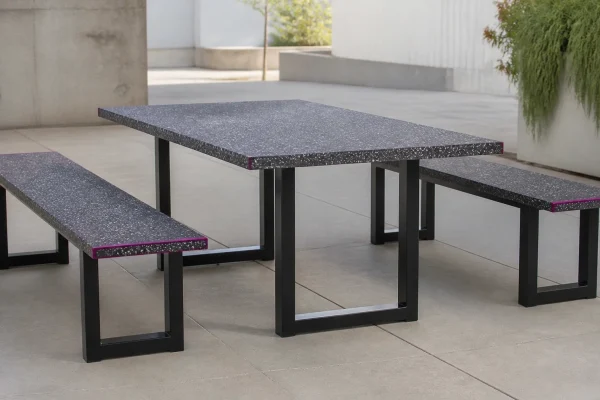
- Installation: You use our panels for fit-outs, hoardings, or furniture.
- Usage: The material serves its purpose (it’s waterproof, UV-stable, and rot-proof).
- Recovery: When the project is decommissioned, we collect the products free of charge.
- Remanufacturing: We granulate the old panels and turn them back into new sheets.
This "waste-to-infrastructure" model effectively removes "end-of-life" from your procurement vocabulary, fulfilling the GBCA's requirement for Product Stewardship.
Comparing Materials: Recycled Plastic vs. The Old Guard
When you're trying to lower your project's carbon footprint, you have to look at the alternatives. Here is how our recycled panels stack up against traditional materials used in commercial interiors and infrastructure.
| Material | Carbon Impact | Circularity Potential | Maintenance |
|---|---|---|---|
| Virgin Timber | Medium | Low (Often ends in landfill) | High (Needs sealing/staining) |
| Virgin Plastic | High | Low | Low |
| Concrete | Very High | Low | Low |
| 100% Recycled Plastic | Very Low ✅ | Excellent (100% Recyclable) ✅ | Zero Maintenance ✅ |
By replacing plywood or concrete with recycled plastic, you aren't just saving the planet: you're saving on long-term maintenance and replacement costs.

Practical Steps: Your 2026 Circular Procurement Checklist
Ready to integrate circular construction into your next tender? Follow these steps to ensure your project is compliant and competitive:
- ✅ Specify 100% Recycled Content: Don't settle for "contains recycled material." Ensure the product is 100% recycled to maximize your points.
- ✅ Demand Local Traceability: Ask your supplier for proof of Australian origin. This reduces "A4" stage emissions (transportation).
- ✅ Check for a Take-Back Scheme: Ensure there is a documented agreement for the manufacturer to reclaim the material at end-of-life.
- ✅ Request an EPD: Ensure your supplier provides an Environmental Product Declaration. This is the "nutrition label" for the material's carbon footprint.
- ✅ Design for Deconstruction: Use mechanical fixings (screws) rather than glues so the panels can be easily removed and recycled later.
Future-Proofing Your Next Project
The transition to circular construction 2026 is more than just an environmental shift; it's a smart business move. Builders and developers who can demonstrate a proven track record of reducing embodied carbon and managing materials in a closed loop will have a massive competitive advantage in both government and private tenders.
Whether you're looking for recycled plastic sheets for construction or bespoke furniture for a commercial fit-out, Resourceful Living provides the material data and the circularity framework you need to succeed.
Ready to earn those Green Star points?
Contact our team today to discuss your next project and how we can help you close the loop on your material procurement.