If you’re currently in the middle of planning a commercial fit-out in Australia, you know the drill. You need surfaces that look great, handle the heavy lifting of daily use, and: increasingly: don’t ruin the planet.
For a long time, engineered stone was the default choice. It’s hard, it’s shiny, and it’s everywhere. But as we move further into 2026, the conversation is shifting. Designers, builders, and business owners are looking for alternatives that align with a circular economy without sacrificing performance.
Enter recycled plastic worktops. Specifically, the 100% recycled Australian plastic panels we manufacture here at Resourceful Living.
So, how do they actually stack up against the industry giant? Let’s break down the pros, the cons, and the cold, hard facts so you can make the best choice for your next project.
1. The Environmental Footprint: High-Energy vs. High-Impact
When we talk about "green" buildings, we often focus on the energy used once the doors open. But the embodied carbon: the energy used to create the materials themselves: is where the real battle is won or lost.
Engineered Stone
Engineered stone is made by binding crushed stone (usually quartz) with polymer resins. While it uses "waste" stone, the production process is incredibly energy-intensive. It requires high heat and massive amounts of water. Plus, once an engineered stone benchtop reaches the end of its life, it usually heads straight to a landfill. It isn’t easily recyclable, meaning it’s a "linear" product.
Recycled Plastic
Our worktops are made from 100% post-consumer and post-industrial plastic waste right here in Australia. We’re talking about the lids, bottles, and soft plastics that would otherwise be clogging up our oceans or sitting in a hole in the ground.
- Low Emissions: The process to melt and press our panels uses significantly less energy than stone manufacturing.
- Zero Waste: Every offcut in our factory goes back into the machine to make a new board.
- Circular by Design: Unlike stone, our products are part of a circular loop.
2. Weight and Installation: The "Back-Breaker" Factor
In the construction world, time is money, and weight is a headache. This is one of the biggest practical differences between the two materials.
Engineered stone is heavy. Really heavy. This means:
- You need more people on-site to move and install it.
- The cabinetry underneath must be reinforced to handle the load.
- Transportation costs (and the associated carbon emissions) are much higher.
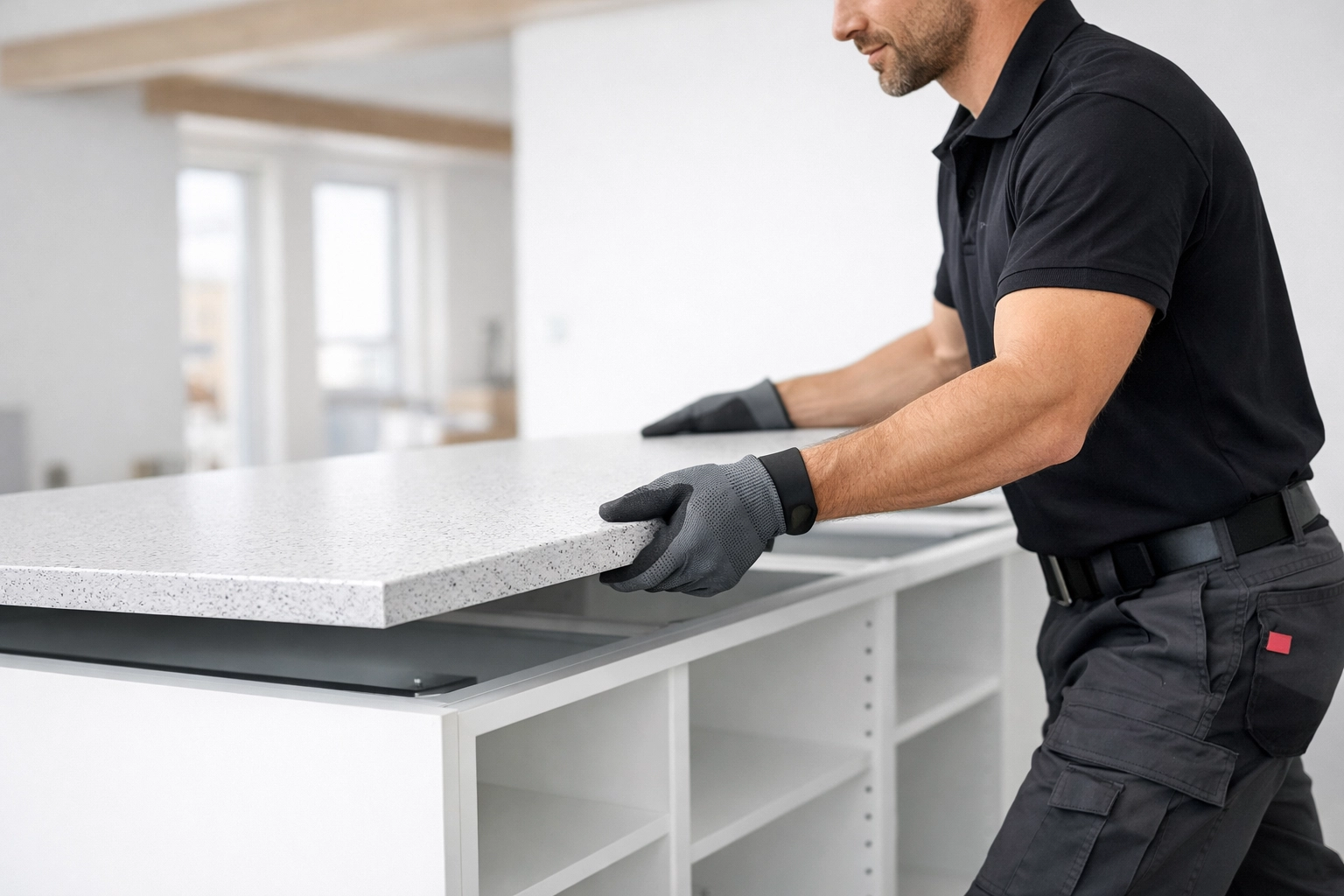
Recycled plastic worktops are approximately one-third the weight of stone.
Because they are lightweight, they are much easier to transport and install. A single joiner or shopfitter can often handle a plastic panel that would require three people if it were stone. This doesn't just save your installers' backs; it directly reduces your labour costs on-site.
3. Durability and Maintenance: Can it Handle the Hustle?
Commercial environments are tough. Whether it’s a bustling cafe, a high-traffic office kitchen, or a retail counter, surfaces take a beating.
Resistance to Cracking
Engineered stone is very hard, which makes it scratch-resistant. However, that hardness also makes it brittle. If a heavy tool or a keg is dropped on a stone edge, it can chip or crack. Repairing stone is difficult and often leaves a visible scar.
Recycled plastic is highly impact-resistant. It has a slight "give" that stone lacks. It won't shatter, chip, or crack under impact. While it is more susceptible to fine surface scratches than quartz, these can often be buffed out, and the "variegated" nature of the recycled patterns makes minor wear and tear almost invisible.
Moisture and Stains
Both materials are non-porous. This is a massive win for commercial hygiene.
- Stone: Resists stains well but can be affected by certain acids or harsh chemicals.
- Recycled Plastic: Completely waterproof. It won't swell, rot, or delaminate even if it's submerged. This makes it perfect for rehabilitated areas or spaces prone to high moisture.
4. The Health and Safety Reality
We can't talk about engineered stone in Australia without mentioning the health risks associated with crystalline silica. The dust created when cutting stone has led to a major shift in workplace safety regulations.
While "low-silica" stone options are now available, they still require incredibly strict (and expensive) safety protocols during fabrication.
Recycled plastic contains zero silica.
Cutting, drilling, and finishing our panels is just like working with timber. It’s safer for the tradies on the tools and doesn't require the same level of specialised, high-cost extraction equipment.
5. Cost Comparison: The Bottom Line
When comparing the price per square metre, recycled plastic and mid-range engineered stone are often quite similar. However, the total project cost usually tells a different story.
| Feature | Engineered Stone | Recycled Plastic (Resourceful Living) |
|---|---|---|
| Material Cost | Moderate to High | Competitive / Moderate |
| Installation Cost | High (Heavy, requires specialists) | Low (Lightweight, standard tools) |
| Maintenance | Low (But repairs are hard) | Low (Easy to buff/refurbish) |
| End-of-Life Cost | High (Landfill levies) | $0 (With our Take-Back Program) |
By choosing a lighter material that is easier to work with, you're saving on the life cycle environmental impact and your budget.
6. The "Take-Back" Program: Closing the Loop
This is where we really leave engineered stone in the dust. When a commercial fit-out is renovated or decommissioned, the "old" materials usually become a liability. You have to pay someone to haul it away, and you have to pay sky-high landfill costs.
At Resourceful Living, we offer a Take-Back Program.
If you use our panels and eventually decide to change your fit-out, we don't want those panels to go to the tip. We’ll take them back, grind them down, and turn them into brand-new boards.
"True sustainability isn't just about what a product is made of; it's about where it goes when you're finished with it."
This circular approach isn't just a win for the environment; it’s a savvy business move. You can find more about how this works on our main website.
7. Aesthetics: The Unique Look
Let’s be honest: engineered stone can look a bit "cookie-cutter." If you want your commercial space to stand out, you need something with a story.
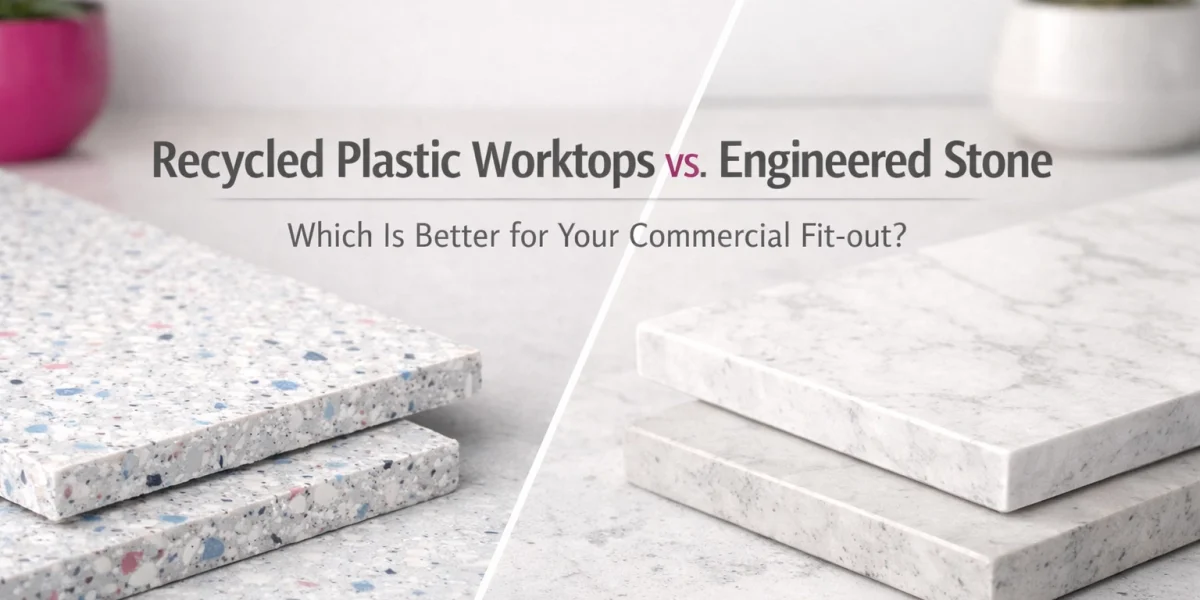
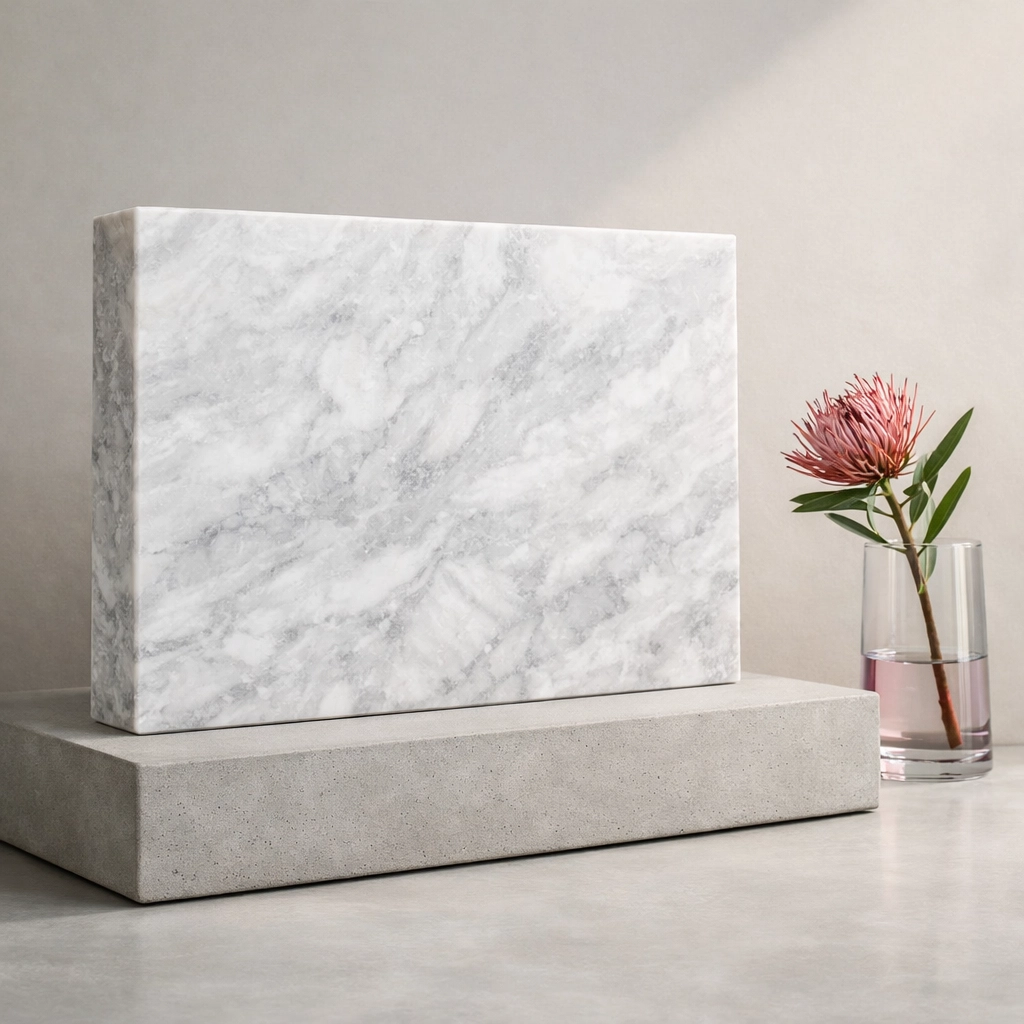
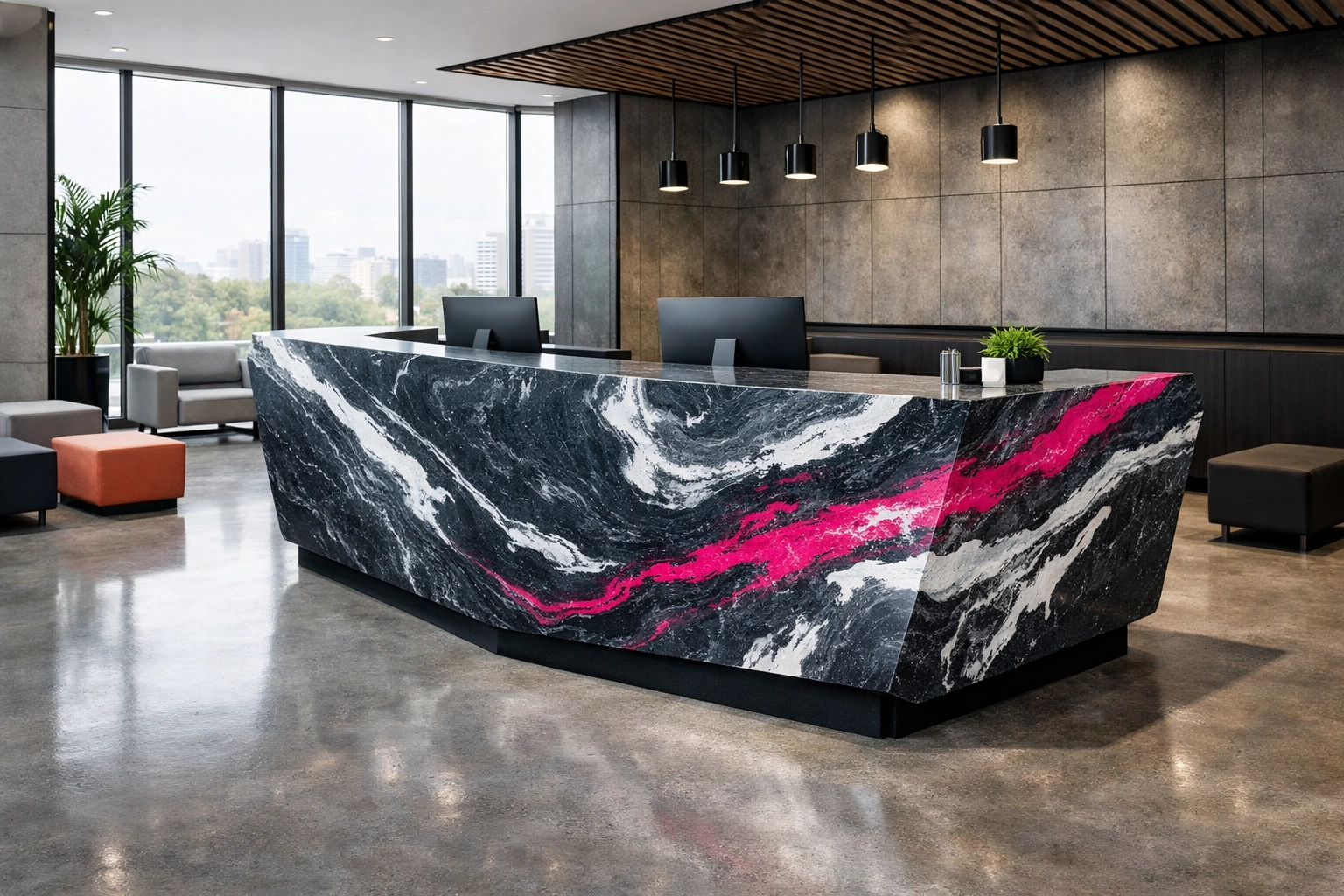
Our recycled plastic panels have a unique, marble-like aesthetic that is entirely dictated by the waste stream we’re using. You get a one-of-a-kind finish that serves as a visual talking point for your brand’s commitment to the environment. Whether you want a clean, "Salt & Pepper" look or a vibrant, multi-coloured statement piece, we can make it happen.
Summary: Which One Should You Choose?
Choose Engineered Stone if:
- You need extreme scratch resistance for a heavy-duty kitchen prep area.
- You are strictly looking for a traditional, high-gloss quartz look.
Choose Recycled Plastic if:
- You want to meet Net Zero or Green Star targets.
- You want to support Australian manufacturing and use 100% recycled materials.
- You need to reduce installation time and labour costs.
- You want a circular solution that won't end up in a landfill.
- You’re looking for a safer, silica-free work environment for your team.
Ready to make the switch?
If you're looking for eco-friendly building products in Australia in 2026, we’d love to help. We’ve seen our panels used in everything from office breakout spaces to mining site products.
The shift toward sustainable construction isn't just a trend: it's the new standard. By choosing recycled plastic over traditional stone, you're not just building a better office; you're building a better future for Australia.
Have questions about a specific project? Check out our product range or get in touch with the team today. Let’s build something resourceful together.