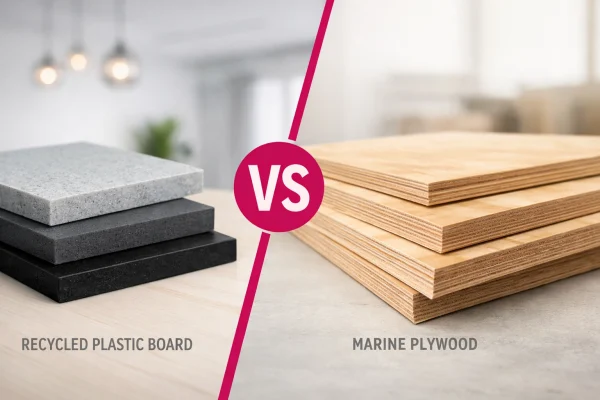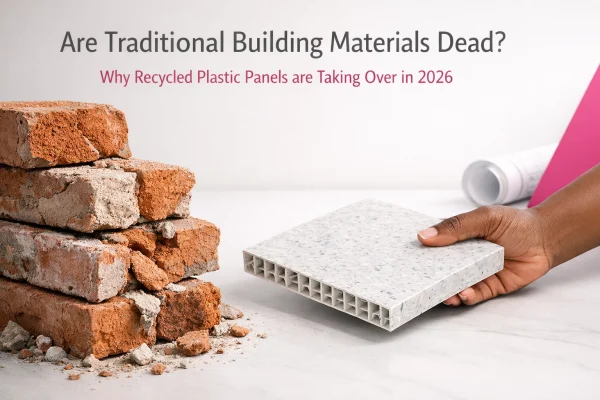
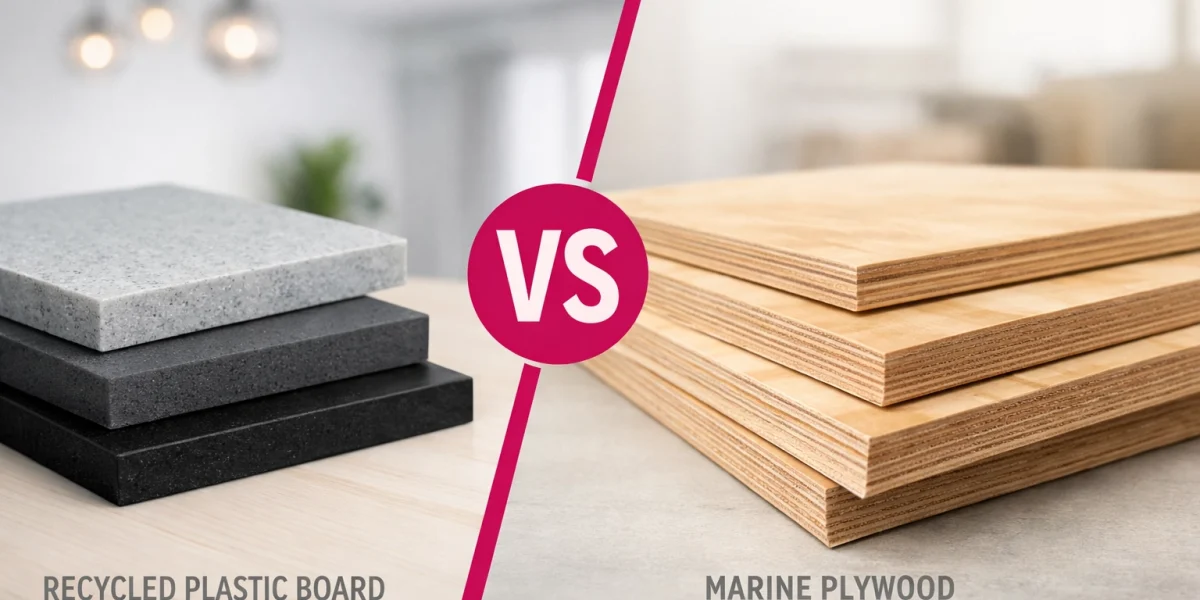
If you’ve been in the commercial fit-out game for more than a minute, you know the drill. When a project calls for durability in a "wet" or high-traffic environment, think end-of-trip facilities, retail joinery, or outdoor hospitality, the default answer has almost always been marine plywood.
It’s the old faithful. It’s sturdy, it’s familiar, and it’s got that "marine-grade" stamp that makes everyone feel a bit safer about moisture. But as we move deeper into 2026, the conversation is shifting. Designers and builders are no longer just asking "will it last?" they’re asking "where does it go when we're done?" and "is there a better way to hit our ESG targets?"
Enter the challenger: recycled plastic board.
Specifically, the 100% Australian-made panels we produce here at Resourceful Living. In this guide, we’re going to put these two heavyweights in the ring to see which one actually deserves a spot in your next commercial fit-out.
The Composition: What Are You Actually Installing?
To understand how these materials perform, we have to look at what they’re made of.
Marine Plywood
Marine ply is a high-quality structural timber made from thin layers of wood veneer (usually hardwood) glued together with waterproof structural adhesive (typically Phenolic resin). To meet the Australian Standard (AS/NZS 2272), it must have zero core gaps to prevent water from getting trapped.
Recycled Plastic Board
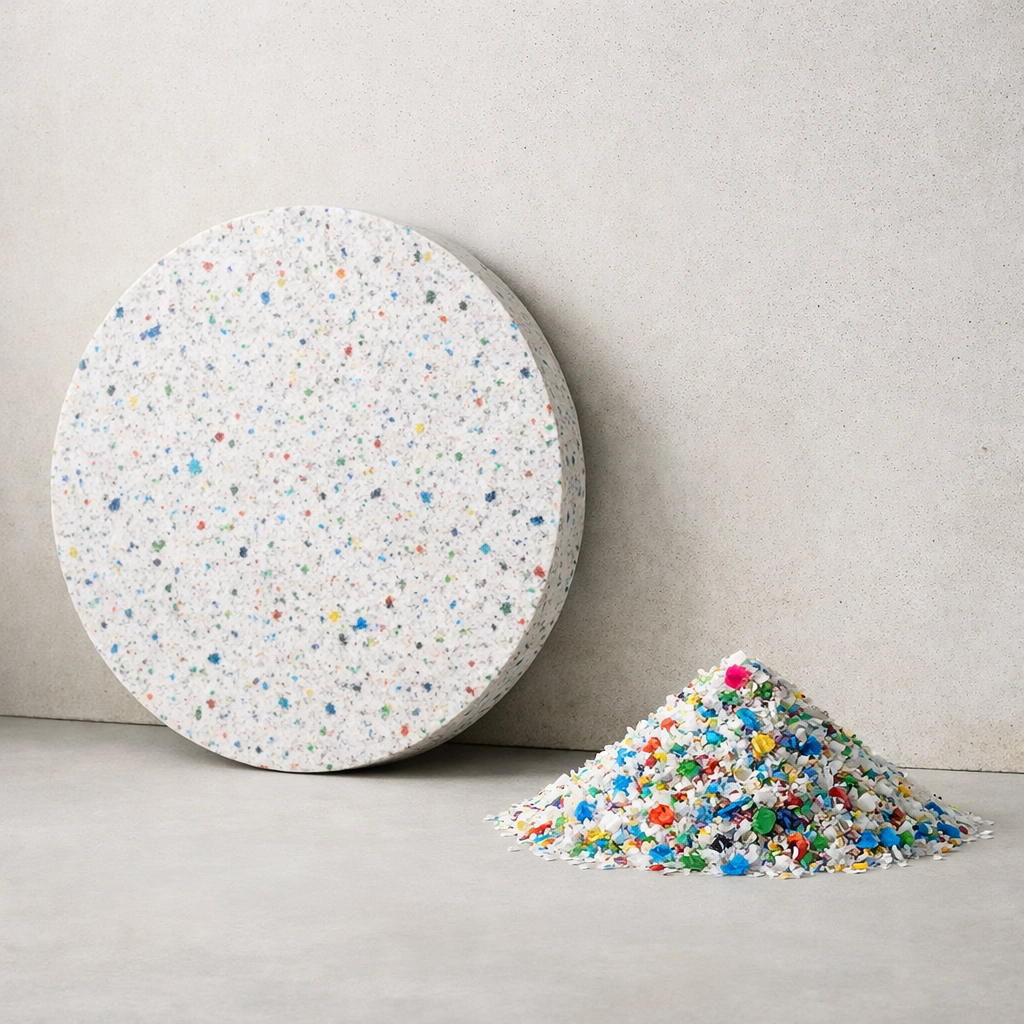
Our recycled plastic board is a completely different beast. It is manufactured from 100% Australian post-consumer and industrial plastic waste, mostly HDPE (High-Density Polyethylene) and LDPE (Low-Density Polyethylene).
Unlike plywood, there are no glues, no resins, and no additives. It’s pure polymer, heat-pressed into a solid, homogenous sheet. This lack of "ingredients" is exactly what makes it a powerhouse for sustainable construction materials in Australia.
1. Durability and Water Resistance: The "No-Rot" Reality
In a commercial setting, moisture is the silent killer of fit-outs.
- Marine Plywood: While "marine" grade means the glue won't fail in wet conditions, the wood fibres themselves can still absorb moisture. Over time, if the edges aren't sealed perfectly or if the surface is scratched, the timber will swell, warp, and eventually rot. It’s an organic material trying to survive in a non-organic environment.
- Recycled Plastic Board: Plastic is naturally hydrophobic. It doesn't just "resist" water; it’s completely impermeable to it. You could submerge a Resourceful Living panel in the ocean for a decade, and it would come out with the exact same structural integrity. For commercial kitchens, bathrooms, or coastal retail spaces, this is a total game-changer.
Key Takeaway: If your project involves any risk of water exposure, recycled plastic board wins on longevity. It is 100% rot-proof, whereas marine ply is simply "rot-resistant" for a limited time.
2. Maintenance: Sanding vs. Wiping
Let’s talk about the "hidden" cost of commercial fit-outs: Maintenance.
Marine plywood requires a significant amount of "babying." To keep it looking good and performing well, it needs to be sanded, stained, or painted, and those coatings need to be reapplied every few years. In a high-traffic retail environment, that’s a lot of downtime and labour cost.
Recycled plastic board requires zero maintenance.
- No painting.
- No staining.
- No sealing.
- UV-stabilised (so it won't fade or crack in the Aussie sun).
The colour and pattern are consistent throughout the entire thickness of the board. If a trolley dings a corner in a supermarket fit-out, you don't see a different coloured core; you just see more of the same material. For a deeper look at why this saves you money in the long run, check out the ROI of recycled plastic sheets vs timber.
3. The Sustainability Factor: Circularity vs. Landfill
This is where the gap between the two materials becomes a canyon.
When a commercial fit-out is decommissioned (which happens every 5–7 years in retail), where does the material go?
- Marine Plywood: Because it’s infused with chemical glues and often covered in laminates or paints, marine ply is incredibly difficult to recycle. Most of it ends up in landfill. It’s a linear "take-make-waste" model.
- Recycled Plastic Board: This is the definition of circularity. Our boards are made from waste that was destined for landfill, and at the end of the fit-out’s life, the boards themselves are 100% recyclable.
At Resourceful Living, we run a take-back program. If you use our panels in a fit-out and that fit-out gets ripped out five years later, we will take the material back, shred it, and turn it into new boards. This is what we call closed-loop manufacturing in Australia.
4. Aesthetics and Design Flexibility
For a long time, "recycled" meant "ugly." That’s no longer the case.
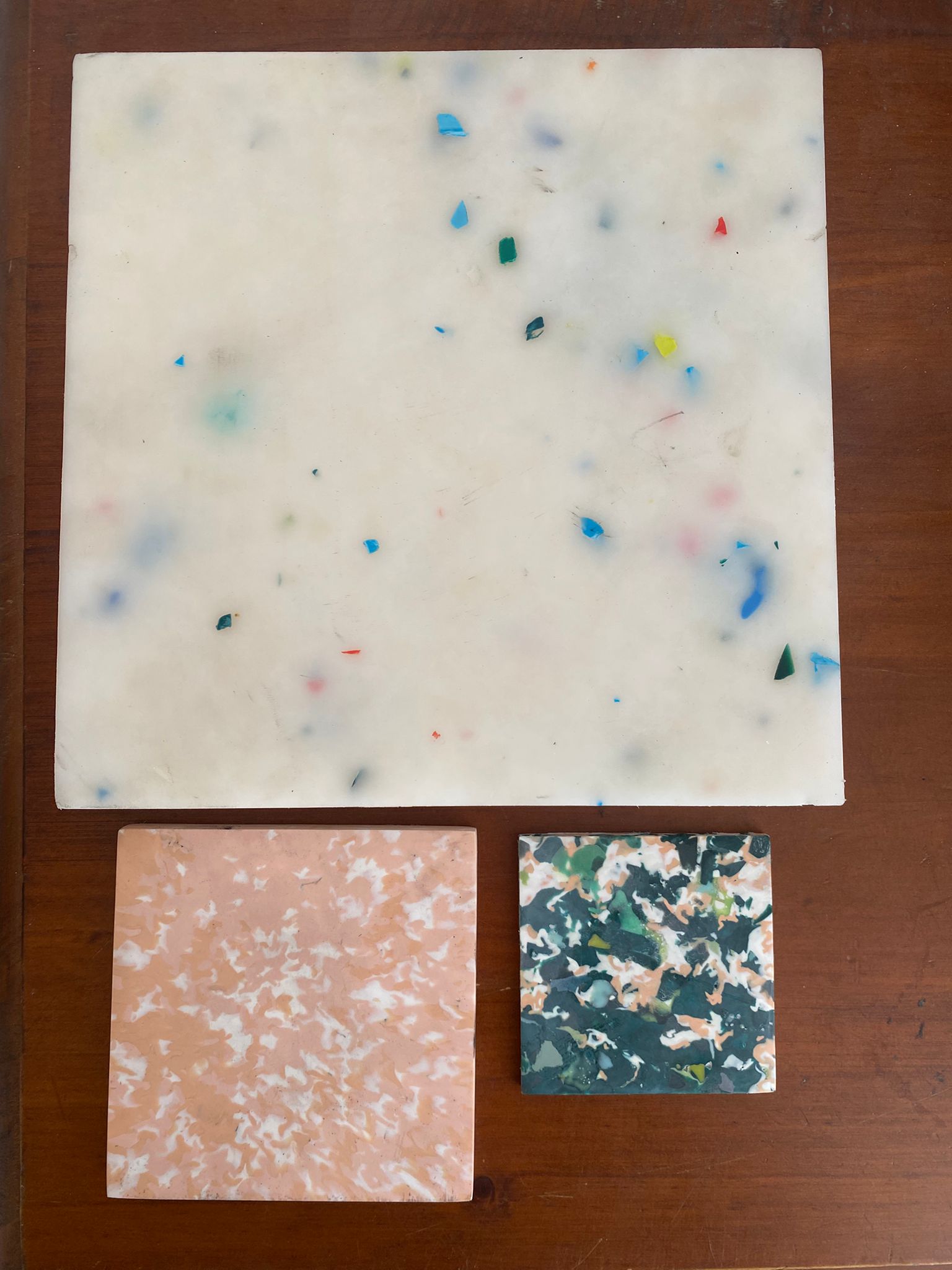
While marine plywood offers a classic wood grain, it can feel a bit "same-y." Recycled plastic boards offer a unique, architectural aesthetic that tells a story. From our 'N70 White Confetti' (a clean white base with pops of colour) to our 'Navy White Marble', these panels are being used as hero features in high-end fit-outs.
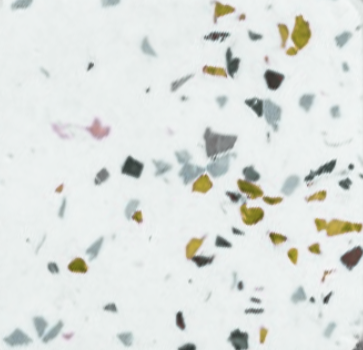
Because the material can be worked with standard woodworking tools (CNC routed, sawn, drilled), you don't need to change your fabrication process. You can create intricate patterns, branded signage, or seamless joinery that simply isn't possible with the layered structure of plywood.
Comparison at a Glance: Marine Ply vs. Recycled Plastic
| Feature | Marine Plywood | Recycled Plastic Board |
|---|---|---|
| Water Resistance | High (Glue-based) | Absolute (Polymer-based) |
| Rot/Termite Proof | No | Yes |
| Maintenance | High (Requires sealing/painting) | Zero (Self-finishing) |
| Sourcing | Often Imported Timber | 100% Australian Waste |
| End of Life | Landfill | 100% Recyclable (Circular) |
| VOCs / Glues | Contains Resins/Formaldehyde | Zero Additives / No Glues |
5. Supporting the Local Economy
When you specify marine plywood, there’s a high chance the timber was harvested overseas and shipped across the globe.
When you choose recycled plastic board, you are directly supporting the Australian circular economy. Every sheet we produce represents kilograms of plastic diverted from Australian landfill and processed in our own facilities. We even offer onsite mobile recycling units for major partners to close the loop on their own waste streams.
This local sourcing isn't just a "feel-good" stat; it’s a massive advantage for your supply chain. You aren't waiting on international shipping containers or dealing with global timber shortages. You’re dealing with a local manufacturer who understands the Australian building landscape.
The Verdict: Which Is Better for Your Fit-out?
If you are working on a low-budget, temporary internal partition where moisture isn't an issue and sustainability isn't a priority, marine plywood is a functional, cheap option.
However, if you are designing for longevity, zero maintenance, and true environmental impact, recycled plastic board is the clear winner. It solves the "disposable fit-out" problem by providing a material that is as durable as it is sustainable.
By switching to recycled plastic, you aren't just choosing a board; you're choosing to be part of the solution to Australia's plastic crisis.
Ready to see the material in person?
Explore our range of 100% recycled plastic panels or download our Designers' Cheat Sheet to learn how to integrate circular principles into your next commercial project.
Let's build something that actually lasts: and that the planet doesn't have to pay for later.