
The Australian building industry is currently facing a massive regulatory shake-up. If you’ve been keeping an eye on the National Construction Code (NCC) 2025, you’ll know that the rules around moisture management, waterproofing, and substrate performance are getting significantly tighter.
For years, the industry relied on plywood, MDF, and particleboard for wet-area fit-outs. But as the 2025 standards kick in, these "old-school" materials are increasingly becoming a liability for builders and developers. The risk of rot, mould, and structural failure is no longer just a maintenance headache: it’s a compliance nightmare.
Enter recycled plastic sheets in Australia. Specifically, 100% recycled High-Density Polyethylene (rHDPE) panels. These aren't just a "green" alternative; they are the logical, high-performance solution to the strict moisture requirements of NCC 2025 Spec 26 and Part 10.2.
The NCC 2025 Shift: Why Moisture Specs Are Changing
The upcoming NCC updates focus heavily on Water Management (Section F) and Wet Area Waterproofing (Part 10.2). The goal is simple: eliminate building failures caused by water ingress.
Volume One: Specification 26 (Commercial & Multi-Res)
Spec 26 applies to Class 2-9 buildings. The 2025 updates tighten the requirements for building elements in wet areas, ensuring they are either waterproof or water-resistant. One of the most significant changes is the inclusion of Class 7 and 8 buildings in the water performance framework: meaning warehouses and industrial sites now face the same scrutiny as apartments.
Volume Two: Housing Provisions Part 10.2 (Residential)
For Class 1 (houses) and Class 10 buildings, Part 10.2 sets the "Deemed-to-Satisfy" (DTS) pathway. A critical takeaway here is the elimination of particleboard as a water-resistant floor substrate in wet areas. If you’re building a laundry or bathroom, the substrate must be inherently resistant to moisture.

Why Traditional Materials are Failing the Test
For decades, builders have used "moisture-resistant" (MR) timber products. The problem? "Resistant" isn't the same as "proof."
- Plywood and MDF: Even with marine-grade glues, timber is porous. Over time, humidity and minor leaks lead to swelling, delamination, and the inevitable growth of mould.
- The "Particleboard Problem": NCC 2025 is effectively phasing out particleboard in high-risk areas because it acts like a sponge. Once moisture hits the core, the structural integrity is gone.
- Maintenance Cycles: Timber-based materials in wet areas usually have a lifespan of 5–15 years before they need replacing. In a modern circular economy, that’s simply not good enough.
When you compare recycled plastic vs marine plywood, the total cost of ownership for plastic is significantly lower because it removes the maintenance and replacement cycle entirely.
The 100% Waterproof Solution: rHDPE Panels
At Resourceful Living, we manufacture panels from 100% Australian recycled plastic. Because these panels are made from solid rHDPE or PP, they are 100% non-porous.
1. Zero Water Absorption
Unlike timber, our sheets don't absorb a single drop of water. This makes them ideal for the "waterproof" zones defined in NCC Spec 26. Whether it’s a shower wall cladding (which now needs to be waterproof to 1800mm) or a laundry cabinet carcass, rHDPE will never swell or rot.
2. Naturally Mould and Termite Proof
Mould requires an organic food source and moisture to grow. Since plastic is inorganic and non-porous, mould can’t take root. Similarly, termites have zero interest in recycled plastic, removing the need for harsh chemical treatments often required for sustainable building materials in Australia.
3. Structural Integrity and Falls
NCC 2025 places a huge emphasis on structural falls (minimum 1:80 for external and 1:100 for internal substrates). Our panels are rigid and maintain their dimensions regardless of humidity levels. This stability ensures that your carefully planned drainage falls remain consistent over the life of the building.
Designing for Circularity and Carbon Reporting
Choosing materials for your next project isn't just about moisture; it’s about meeting Embodied Carbon targets. By 2026, reporting on the carbon footprint of your materials will likely be mandatory for many government and large-scale commercial tenders.
Our recycled plastic sheets in Australia offer a double-win:
- Low Embodied Carbon: We use 100% Australian waste, reducing the carbon footprint associated with virgin material production and international shipping.
- The Take-Back Program: We manage the end-to-end cycle. When your fit-out eventually reaches its end of life (which won't be for 50+ years), we’ll take the material back for free to remanufacture it into new products.
This level of local traceability is exactly what specifiers need to win government tenders in 2026.
"The shift toward recycled plastic isn't just about 'being green.' It's a strategic move to de-risk projects against moisture failure while meeting the new NCC 2025 standards." : Jess Hodge, Resourceful Living.
Technical Specifications: What You Need to Know
If you're writing a spec for a wet area fit-out, here are the technical benchmarks to include to ensure compliance:
| Feature | Specification for NCC 2025 Compliance |
|---|---|
| Material Type | 100% Recycled HDPE or PP (No fillers/wood flour) |
| Moisture Resistance | 100% Waterproof / Non-porous |
| Sheet Size | 2400mm x 1200mm (Standard) |
| Thickness | 12mm – 19mm (Typical for cabinetry/cladding) |
| Compliance | Must be 100% recyclable with a documented take-back scheme |

Installation: Pro Tips for the Site Team
While recycled plastic is a superior moisture barrier, it does behave differently than timber on-site. To ensure your NCC 2025 compliant project runs smoothly, keep these installation tips in mind:
- Thermal Expansion: Unlike timber, which moves with moisture, plastic moves with temperature. Always allow for a 3mm expansion gap between panels.
- Tooling: You don't need special equipment. Standard carbide-tipped woodworking tools work perfectly for cutting, drilling, and routing our sheets.
- Adhesives: For wet area wall cladding, use a high-quality flexible adhesive that allows for thermal movement.
- Fasteners: Always use stainless steel fixings in wet areas to match the longevity of the plastic panels.
How to Meet 2026 Recycled-Content Targets Today
Builders who wait until the last minute to adapt to these changes risk falling behind. Early adopters are already using recycled plastic panels to secure tenders and future-proof their builds.
By switching to rHDPE for your bathroom cabinetry, laundry fit-outs, and wall cladding, you are:
✅ Meeting the strict moisture requirements of NCC 2025.
✅ Eliminating the risk of rot and mould.
✅ Diverting 30kg+ of plastic from Australian landfill per sheet.
✅ Building a circular legacy that lasts for generations.

Ready to Spec Your Next Project?
The transition to a circular, moisture-secure built environment is already happening. Don't let your next project be held back by outdated materials that can’t stand up to the new NCC standards.
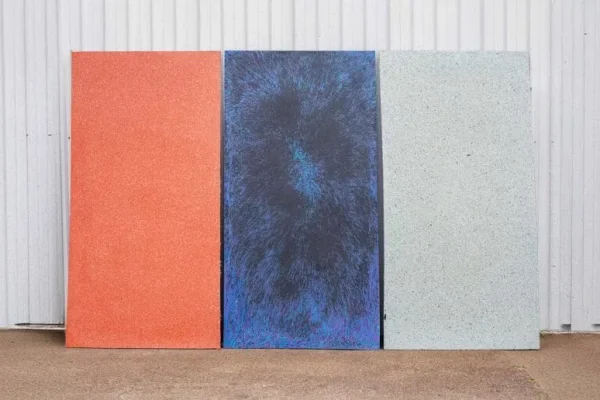
At Resourceful Living, we’re here to help you navigate the shift. Whether you need technical data sheets for a tender or custom colour matching for a retail fit-out, our Australian-made panels are the answer.
Explore our full range of 100% recycled plastic sheets or contact us today to discuss how we can de-risk your next wet-area build.