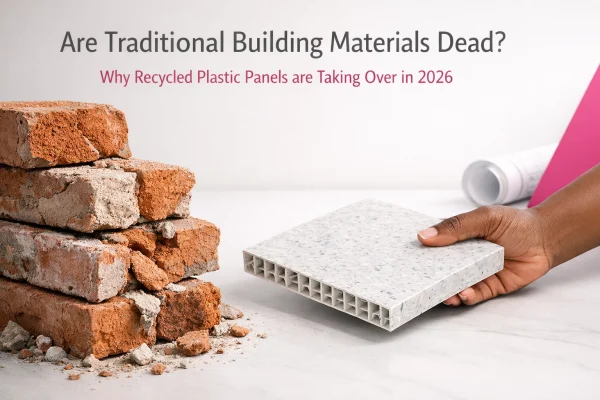

Let’s delve straight in, recycled plastic vs concrete. Concrete is the most widely used man-made material in the world. It’s also one of the most environmentally damaging, responsible for up to 8% of global CO2 emissions. In contrast, recycled plastics are emerging as a sustainable alternative in specific construction applications with significantly lower carbon footprints and greater circularity.
In this comparison, we break down the full life cycle impact of both materials to help you make smarter, greener choices for your next build.
Concrete: The Backbone of Construction (With a Heavy Footprint)
Environmental Costs of Concrete:
- High Embodied Energy: The production of cement is highly energy-intensive and emits large volumes of CO2.
- Non-Renewable Resources: Requires sand, gravel, and limestone, depleting natural landscapes.
- Water Consumption: Massive volumes of water are needed to cure concrete.
- End-of-Life Waste: Concrete is difficult to recycle effectively and often ends up as rubble or landfill.
While concrete is structurally critical for buildings, infrastructure, and roadways, its environmental impact is staggering particularly during extraction and manufacturing phases.
Recycled Plastic Panels: A Smarter Alternative for Many Applications
Recycled plastic panels are made from post-consumer waste like milk jugs, plastic bags, and packaging. Instead of sending that plastic to landfill or the ocean, it’s reprocessed into durable, weather-resistant building materials.
Key Sustainability Benefits:
- Zero New Resource Extraction: Manufactured entirely from waste material.
- Lower Carbon Footprint: No cement, kilns, or burning involved.
- Fully Recyclable: Unlike concrete, which often becomes rubble, recycled plastic can be reused again.
- Lightweight & Energy Efficient: Less transport energy and easy installation.
Applications include:
- Decking
- Cladding
- Retaining walls
- Outdoor furniture
- Raised beds
📦 Explore 100% recycled plastic panels here
Lifecycle Comparison Table
| Impact Factor | Concrete | Recycled Plastic Panels |
|---|---|---|
| Embodied Carbon | High | Low |
| Resource Use | Non-renewable minerals | Reused plastic waste |
| Water Usage | High | Minimal |
| Recyclability | Difficult, often landfill | Fully recyclable |
| Durability | High (structural) | High (non-structural) |
| Applications | Structural, foundations | Landscaping, walls, cladding |
| End-of-Life | Rubble, low reuse | Circular economy integration |
Where Recycled Plastics Outperform Concrete
While recycled plastic isn’t intended to replace concrete in heavy structural use (like skyscraper foundations), it excels in:
- Public landscaping: Boardwalks, benches, bollards
- Outdoor spaces: Cladding, planter boxes, shade structures
- Low-load applications: Garden walls, furniture, signage
Switching to recycled plastic in these use cases:
- Cuts emissions by up to 60%
- Prevents tonnes of plastic from reaching landfill
- Reduces ongoing maintenance and repair costs
🔗 See how NSW builders are adopting recycled plastics
Case Studies & Industry Trends
- City of Sydney replaced timber slats in park benches with recycled plastic, cutting costs and boosting durability.
- Regional councils across NSW and QLD are mandating recycled plastic in procurement policies for public assets.
- The Australian Government’s ReMade in Australia initiative encourages use of 100% recycled materials in public infrastructure.
These trends show growing momentum behind recycled plastic as a viable alternative in non-structural applications.
Compliance, Credits & Certifications
Using recycled plastics contributes to:
- Green Star Materials Credits
- NABERS waste efficiency
- ISO 14001 Environmental Management compliance
Builders using recycled products are increasingly being favoured in government tenders and ESG-aligned developments.
✅ Learn how to meet Green Star targets with recycled materials
Final Thoughts
Concrete will always have a place in construction, but it’s no longer the default for every application. By replacing concrete with recycled plastics in appropriate areas, you:
- Lower your project’s carbon footprint
- Reduce long-term maintenance
- Support Australia’s circular economy goals
Return to: The Ultimate Guide to Sustainable Building Materials in Australia
🛒 Get eco-friendly recycled plastic panels today